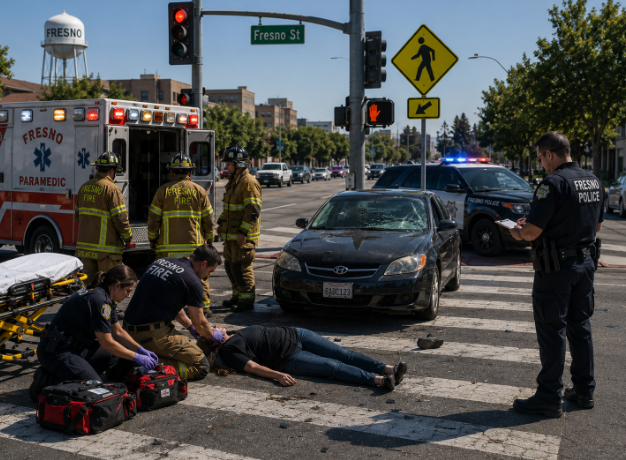
Someone on foot has nothing between them and the vehicle, so a collision that would dent a car does lasting damage to a person. And almost every one of these claims turns into an argument about where you were standing.
That argument is answerable. Being in the roadway is not the same as being at fault for being there, and California reduces a recovery in proportion to fault rather than barring it.
Culver Legal, LLP represents injured pedestrians across the Central Valley from an office at 1690 W Shaw Avenue, Suite 220 (by appointment only) in Fresno. We work on contingency and advance the costs of the case, so there is nothing to pay up front and no fee unless we win. If there is no recovery, you are not charged those costs either. Call (310) 600-7881 at any hour.
When Does a Driver Have to Yield?
Vehicle Code 21950 requires a driver to yield to a pedestrian crossing within any marked crosswalk or within an unmarked crosswalk at an intersection.
That second half is the part people do not know, and it decides a lot of these cases. An unmarked crosswalk exists at most intersections whether or not anything is painted on the road. Crossing at a corner with no paint is not the same as crossing mid-block, and an adjuster who describes it that way is describing something the statute does not.
The same section also requires drivers to exercise due care and reduce speed for pedestrian safety, and it says a pedestrian’s right of way does not relieve them of using ordinary care. Both halves are real, which is why these claims are argued rather than conceded.
Told you were not in a crosswalk?
An unmarked crosswalk exists at most intersections. Paint is not what creates the right of way.
Is It Always the Driver’s Fault?
No, and any page telling you otherwise is setting you up for a disappointing conversation. Fault is decided on the facts of the individual collision.
What matters far more is what happens when fault is shared. California is a pure comparative fault state. If you are found partly responsible, your recovery is reduced by that percentage rather than eliminated. A pedestrian found 30% at fault recovers 70%, and on a serious injury that is not a technicality.
So the argument is almost never whether you have a claim. It is what the percentage should be, and that is an evidence question: where the vehicle struck you, the point of impact on the car, the lighting, the sight lines, and whether the driver was doing what 21950 requires.
How Dangerous Is It on Foot in Fresno?
More carefully than most pages will tell you, and the honest answer is more useful than the alarming one.
The California Office of Traffic Safety publishes crash rankings drawn from statewide collision data. Fresno is measured against the 15 California cities with populations over 250,000, and a rank of 1 is the worst. Across most categories Fresno ranks 9th to 15th, meaning near the safer end of that group, and in 2023 pedestrians overall came in 8th of 15 at 202 killed or injured.
One category is a genuine and worsening exception.
Children on foot. Pedestrians under 15 killed or injured in Fresno:
- 2021: 16, ranked 6th of 15
- 2022: 24, ranked 3rd of 15
- 2023: 31, ranked 2nd of 15
Second worst of the fifteen largest cities in California, climbing three years running, in a city that ranks near the bottom of that group on almost everything else. Fresno County says the same thing independently: 40 victims under 15, ranked 8th of all 58 counties, against a county ranking 44th to 57th on nearly everything.
Figures are from the CA Office of Traffic Safety with data from SWITRS, for the years shown, and they count people killed and injured together rather than deaths alone. The figures start in 2020 because Fresno’s official totals for 2017 and 2018 read 70 and 27 people for a city of more than half a million, while its police made more than 1,300 DUI arrests in each of those years; see how we checked.
Why that matters to a claim rather than to a headline. Where the injured pedestrian is a child, the comparative-fault argument that carries most of these cases is much weaker. A young child cannot be held to an adult’s standard of care, and the argument that they should have been more careful is a far harder one for a defendant to run than it is against an adult.
Where Will You Be Treated, and Why Do Those Records Decide It?
Community Regional Medical Center, 2823 Fresno Street, describes itself as the only Level I trauma center between Los Angeles and Sacramento, verified at that level by the American College of Surgeons and staffed around the clock.
A pedestrian struck by a vehicle is the kind of injury that goes there, which means one hospital holds the imaging, the trauma activation record and the first responder narrative. Those are three separate documents, held by different custodians, requested separately, and none of them is the discharge summary.
Head injury is the one most often missed on the day. Somebody who was walking and talking at the scene can have a brain injury that only declares itself over the following week, and a normal emergency scan answers the emergency question rather than every question. Keep the paperwork from anywhere you were treated, urgent care included.
Who Wrote the Report, and How Do You Get It?
For a collision on a city street inside Fresno, the report comes from the Fresno Police Department Records section, 2323 Mariposa Street, on (559) 621-2534, open Monday to Friday, 8 a.m. to 4 p.m. Collision reports are ordered online for a $12 convenience fee, charged by the service that fulfills the report rather than by the city.
A collision on Highway 99, Interstate 5 or State Route 41 is normally investigated by the California Highway Patrol instead, so the report is theirs.
If the driver left, an uninsured motorist claim on your own policy can respond even where nobody is ever identified. That is worth checking before concluding there is nothing to pursue.
What If a Public Body Is Involved?
Then the deadline changes and it changes sharply. A claim involving a city or county vehicle, a FAX bus, or the condition of a public road or crossing runs under the Government Claims Act: a written claim within six months under Government Code 911.2, rather than the ordinary two years, and no lawsuit until it has been presented.
For the City of Fresno that goes to the Risk Management Division, 2600 Fresno Street, Room 1030, and the city requires claims to be filed in duplicate.
For an injured child this is the trap that actually costs families their claim. Code of Civil Procedure 352 pauses the ordinary limitation period while an injured person is under 18, which sounds like there is time. It does not pause the six-month government claim. Set against the child-pedestrian figures above, that is the single most consequential thing on this page.

Where Would the Case Be Heard?
At the B. F. Sisk Courthouse, 1130 O Street, which is where Fresno County hears unlimited civil cases, meaning claims above $35,000. A pedestrian struck by a vehicle is almost always in that category, and it is heard before a Fresno County jury.
Was a child hurt walking?
Being under 18 does not pause the six-month government deadline. Call before it runs.
Why Do Fresno Clients Choose Culver Legal?
We are in Fresno, at 1690 W Shaw Avenue, Suite 220 (by appointment only), and where you cannot travel we come to you.
Our team speaks Spanish, Farsi, Filipino, Hindi, Mandarin and Korean.
The economics are simple. Contingency, costs advanced, nothing up front and no fee unless we win. We advance the case costs, and if there is no recovery you are not charged those costs either. Culver Legal has recovered $200 Million and counting, and the phone is answered 24 hours a day.
Fresno Pedestrian Accident FAQs
Is it always the driver’s fault if they hit a pedestrian?
No. Fault is decided on the facts of the collision, and a pedestrian can share it. What matters is that California is a pure comparative fault state, so shared fault reduces the recovery in proportion rather than removing it. Somebody found 30% responsible still recovers 70%. The practical effect is that the argument is about the percentage, not about whether there is a claim, and the percentage is decided by evidence rather than by an adjuster’s first view of it.
I was not in a marked crosswalk. Does that end my claim?
Not by itself, and this is the most common misunderstanding in these cases. Vehicle Code 21950 requires drivers to yield within a marked crosswalk or within an unmarked crosswalk at an intersection, and an unmarked crosswalk exists at most intersections whether or not anything is painted. Crossing at a corner with no markings is a different situation from crossing mid-block, and the two get described identically by insurers.
My child was hit. Is anything different?
Yes, in two ways that matter. A young child is not held to an adult’s standard of care, so the comparative-fault argument that carries most of these cases is much weaker against them. But the deadlines cut the other way: while the ordinary two-year period is paused until a child turns 18, the six-month government claim is not, so where a public entity is involved an adult has to act within months.
The driver drove off. Is there anything left?
Often yes. An uninsured motorist claim under your own policy can respond to a hit and run even where the driver is never identified. It is worth checking your own coverage before assuming there is no route, and it is one of the first things we look at.
How long do I have to bring a claim?
Two years from the date of injury under Code of Civil Procedure 335.1. If a public entity is involved, a written claim must be presented within six months under Government Code 911.2, which is separate and much earlier. The evidence sets a shorter clock still: camera footage from nearby businesses is usually overwritten within days.
I am undocumented. Can I bring a claim without putting myself at risk?
Yes, and the protection is stronger than most people expect. Under Evidence Code 351.2, added by AB 2159, evidence of a person’s immigration status is not admissible in a civil action for personal injury or wrongful death, and discovery into it is not permitted either. It cannot be raised at trial and it cannot be asked about beforehand. It is not a question we ask you, and it is not a question the other side gets to ask.
Contact a Culver Legal Fresno Pedestrian Accident Lawyer
The evidence that decides a pedestrian claim has a short life. Camera footage is overwritten within days, vehicles get repaired, and the first account written down is usually the driver’s. If you or a member of your family was struck anywhere in Fresno or the surrounding Central Valley, reach us at (310) 600-7881 at any hour, or at 1690 W Shaw Avenue, Suite 220 (by appointment only). The review costs nothing.
Attorney Advertising. Prior results do not guarantee a similar outcome. Culver Legal, LLP is a California law firm. The information on this page is for general informational purposes and does not constitute legal advice.