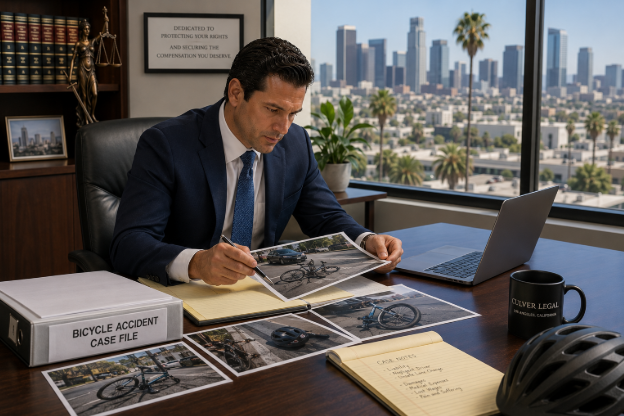
A bicycle accident can change everything in a fraction of a second. Medical bills pile up fast. You may not be able to work. The driver’s insurance company is already building a case against you. If you or someone you love was hit by a vehicle while riding a bicycle in California, you have legal rights that do not depend on the size of the other party, the insurance company they use, or how much fault they try to pin on you.
California cyclists face some of the most dangerous roads in the country. According to the California Office of Traffic Safety, cyclists accounted for more than 130 fatalities and thousands of serious injuries in a single recent year. Most of those crashes involved a motor vehicle. Most of those drivers had insurance. And most of those insurance companies moved quickly to limit what they paid out. You need someone who moves faster.

Do You Need a Lawyer After a Bicycle Accident?
Not every crash requires litigation. But every serious bicycle injury does require legal representation. Here is why: bicycle accident cases are rarely straightforward. The driver’s insurer will look for any way to reduce or deny your claim. They will argue you were riding outside the lane, that your helmet was not properly fastened, that you ran a stop sign, or that your injuries were pre-existing. Without an attorney, you are handling that fight alone while trying to recover from your injuries.
If you suffered broken bones, a head injury, road rash requiring surgery, spinal trauma, or any injury that required hospitalization or kept you from working, you need a lawyer. The cost of a serious bicycle injury in California can exceed six figures when surgery, rehabilitation, lost wages, and ongoing care are factored in. An experienced bicycle accident attorney ensures that figure is what gets put on the table, not whatever the adjuster decides to offer.
Common Causes of Bicycle Accidents in California
Most bicycle crashes involving motor vehicles come down to driver negligence. The most frequent causes Culver Legal sees in cases across California include:
- Dooring accidents: A driver or passenger opens a car door directly into the path of an oncoming cyclist. These crashes happen in seconds and leave cyclists with no time to react.
- Right-of-way violations: Drivers turning right at intersections fail to check for cyclists in the bike lane or shoulder.
- Distracted driving: A driver looking at a phone, changing music, or talking to a passenger drifts into the bike lane or fails to yield.
- Left-turn collisions: A driver turning left misjudges a cyclist’s speed and turns directly into the cyclist’s path.
- Speeding and aggressive driving: Drivers who pass too close or too fast leave cyclists no margin for error.
- Failure to yield at crosswalks and intersections: Cyclists using marked crossings or proceeding through green lights are struck by drivers who do not look.
- Unsafe lane changes: Drivers merging into bike lanes or shoulders without signaling or checking mirrors.
- Poor road conditions: Potholes, debris, broken pavement, or absent markings maintained by a government entity may expose a public agency to liability.
Injuries Cyclists Sustain in Serious Crashes
A cyclist hit by a vehicle has almost no protection. Even with a helmet and proper gear, the physics of the collision mean the human body absorbs an enormous amount of force. Common injuries in bicycle accident cases handled by Culver Legal include:
- Traumatic brain injuries, including concussions and diffuse axonal injury
- Fractured skull, cheekbones, jaw, and facial bones
- Clavicle, wrist, and arm fractures from impact and protective bracing
- Spinal cord injuries, including partial or complete paralysis
- Internal organ damage from handlebar or vehicle impact
- Severe road rash requiring skin grafts
- Knee and hip fractures
- Nerve damage with long-term sensation and mobility effects
- Psychological trauma, including PTSD and anxiety, following the crash
Injuries may not present fully in the first hours after a crash. Adrenaline suppresses pain. Internal bleeding and brain swelling take time to manifest. This is one of the core reasons you should seek medical evaluation immediately, even if you believe you were not seriously hurt.
Expert Legal Tip from the Attorneys at Culver Legal: Do not repair your bicycle before your attorney has documented it. Damage to the frame, wheels, and components tells the story of how the crash happened and where the impact occurred. A repaired or replaced bike eliminates physical evidence that a reconstruction expert could have used to establish fault, speed, and point of contact. Keep it exactly as it was until your attorney says otherwise.
What to Do Immediately After a Bicycle Accident
- Get to safety. If you are on the road, move to the shoulder or sidewalk if you are physically able.
- Call 911. A police report creates an official record of the crash. Do not skip this step, even for minor collisions.
- Do not admit fault. Do not apologize. Do not say “I’m fine.” These statements get used against you.
- Document the scene. Photograph the vehicle, the driver’s plate number, your bicycle, your injuries, and the road conditions from multiple angles.
- Get witness information. Names and phone numbers from anyone who saw the crash are valuable.
- Accept medical evaluation. Either go to the emergency room or follow up with your doctor within 24 hours.
- Do not post about the accident on social media. Insurance investigators monitor claimants’ public accounts.
- Contact a bicycle accident attorney before speaking to the insurance company.
What NOT to Do After a Bicycle Accident
The days immediately following a bicycle accident are the most critical period for your claim. What you say and do in this window shapes the value of your case.
Do not give a recorded statement to any insurance adjuster. The driver’s insurer will contact you quickly, often while you are still in the hospital or in the early stages of treatment. They will frame it as routine. It is not. A recorded statement is a tool to reduce your claim. You are not required to give one, and you should not.
Do not accept an early settlement offer. Insurance companies make fast, low offers to claimants who have not yet seen the full picture of their medical costs. Once you sign a release, you cannot come back for more damages, no matter how serious your injuries become. Let your attorney evaluate the full scope of your losses before any settlement is considered.
Do not skip medical appointments. Gaps in treatment give insurers grounds to argue your injuries were not serious or that you did not follow through with care.
What Not to Say to Insurance Companies
The at-fault driver’s insurer will contact you quickly. That call is evidence collection, not outreach. Specific phrases that damage bicycle accident claims:
- “I might have been too far left” or “I wasn’t in the bike lane.” Any statement about your lane position becomes a California Vehicle Code 21202 argument used to inflate your comparative fault percentage.
- “I’m okay” or “I don’t think I’m badly hurt.” Internal injuries and TBI symptoms frequently do not appear until hours or days after impact. This statement becomes evidence used to minimize your injury claim.
- “I wasn’t wearing a helmet.” California does not require adult cyclists to wear helmets, but saying this unprompted gives the adjuster a direct comparative fault argument for any head injuries.
- Agreeing to give a recorded statement. You are not legally required to. Decline and contact an attorney before any further contact with any insurer.
- Accepting any settlement offer on the call. Early offers are designed to close your claim before surgery, rehabilitation, and future care costs are fully known. Once signed, it is permanent.
California Laws That Apply to Bicycle Accident Claims
California Vehicle Code Section 21202 requires cyclists to ride as far to the right of the roadway as practicable, except when passing, preparing to turn left, or when the lane is too narrow to share safely. This law is frequently cited by defense attorneys to argue the cyclist’s fault. An experienced attorney knows how to rebut these arguments.
California Vehicle Code Section 21760, known as the Three Feet for Safety Act, requires drivers to give cyclists at least three feet of clearance when passing. A driver who passes closer than three feet has violated this statute, and that violation is direct evidence of negligence.
California does not require adult cyclists to wear helmets, but helmet use or the absence of it can be raised in comparative fault arguments. Your attorney will address this if it becomes a factor in your case.
California is a pure comparative fault state. That means your recovery is reduced by whatever percentage of fault is assigned to you, not eliminated. If your case is worth $1,000,000 and you are found 25% at fault, you still recover $750,000. You can file a claim even if you are 99% at fault. Do not let anyone tell you otherwise.
Under California Code of Civil Procedure Section 335.1, you have two years from the date of injury to file a personal injury lawsuit. If the at-fault party is a government entity, such as a city agency responsible for road maintenance, you have only six months to file an administrative claim. Missing either deadline eliminates your right to recover, so do not wait.
For more information on California bicycle laws and cyclist rights, see the California DMV Bicycle Safety and Laws guide. For federal bicycle safety data, see the National Highway Traffic Safety Administration Bicyclist Safety page.
Uninsured and Underinsured Motorist Coverage in Bicycle Accident Cases
Not every driver who hits a cyclist carries adequate insurance. Some carry none. California Insurance Code requires insurers to offer uninsured motorist coverage to policyholders, and that coverage may extend to bicycle accidents where a motorist is at fault. If you were struck by a hit-and-run driver, your own UM policy may be the source of your compensation. Even claims filed against your own insurer under UM/UIM provisions can be disputed, and having an attorney in that process matters significantly.
Insurance Company Tactics You Will Face
Insurance adjusters are trained to close claims for the least amount of money possible. In bicycle accident cases, the tactics they use most often include:
- Arguing you violated California Vehicle Code 21202 to assign you comparative fault
- Disputing the severity of your injuries by questioning whether treatment was necessary or related to the crash
- Obtaining surveillance or reviewing your social media to find evidence that your injuries are less serious than claimed
- Requesting a recorded statement early in the process to gather material that can be used against you later
- Making a fast lowball offer before you have completed medical treatment or understood the full value of your claim
- Arguing that pre-existing conditions account for your current symptoms
An attorney who handles bicycle accident cases regularly knows these tactics before they are deployed. That preparation is worth a significant amount in terms of final case value.

What Compensation Can You Recover?
A successful bicycle accident claim in California can recover both economic and non-economic damages. Economic damages are the concrete, calculable losses tied to your injury:
- Emergency room and hospital costs
- Surgical expenses
- Physical therapy and rehabilitation
- Future medical costs if your injuries require ongoing treatment
- Lost wages during recovery
- Loss of future earning capacity if you cannot return to your previous work
- Bicycle repair or replacement
- Damaged personal property
Non-economic damages are harder to quantify but often represent the largest portion of serious injury cases:
- Pain and suffering
- Emotional distress
- Loss of enjoyment of activities you could do before the crash
- Disfigurement or permanent scarring
- Loss of consortium if the injury affects your relationship with a spouse
In cases involving particularly reckless behavior by the at-fault driver, such as extreme speeding or driving under the influence, punitive damages may also be available.
Can You File If You Are Undocumented?
Yes. California law prohibits using immigration status in personal injury cases. Your right to file a claim does not depend on your citizenship or documentation status. Courts have consistently held that undocumented individuals are entitled to the same legal protections as any other person injured in California. Your status does not affect your right to compensation, and Culver Legal does not require any documentation to evaluate your case.
What If You Were Working When the Accident Happened?
If you were riding a bicycle as part of your job, for example, as a delivery worker or courier, you may be entitled to both workers’ compensation benefits and a civil personal injury claim against the at-fault driver. These two tracks are not mutually exclusive in California. Workers’ comp covers your medical treatment and a portion of lost wages. A civil claim pursues full damages from the responsible driver. An attorney who handles both sides of that analysis gets you more than either path alone.
Questions to Ask Before Hiring a Bicycle Accident Lawyer
The Legal Process: Step by Step
- Free case evaluation. You contact Culver Legal. An attorney reviews your situation, explains your options, and identifies the key facts that will shape your claim.
- Investigation. Your attorney gathers the police report, medical records, witness statements, photographs, and any available surveillance or dashcam footage.
- Demand letter. Once your treatment is complete or a clear picture of future costs is established, your attorney sends a formal demand to the insurance company.
- Negotiation. The insurer responds, and negotiations begin. Your attorney handles every communication. You do not talk to the insurance company.
- Settlement or litigation. Most cases settle before trial. If the insurer refuses to offer fair value, your attorney files a lawsuit in a California civil court.
- Discovery and depositions. Both sides exchange evidence. Witnesses and parties may be deposed. This stage often produces additional leverage toward settlement.
- Trial. If a settlement is not reached, the case goes before a jury. Culver Legal’s attorneys have the trial experience to take a case the full distance.
Why Choose Culver Legal for Your Bicycle Accident Case
Culver Legal has recovered over $1 billion for injured clients across California. Specific results include a $4 million auto accident recovery, a $3.7 million personal injury settlement, a $3.55 million auto accident result, a $3 million truck accident settlement, a $2.5 million commercial accident recovery, and a $2.25 million motorcycle accident settlement. These are real numbers from real cases.
The firm’s attorneys, Thanos Simoudis, David Merabi, Dario C. Gomez, Victoria Manesh, Michael Domingo, and Michael B. Huynh, handle cases across Los Angeles, Long Beach, San Diego, San Francisco, Riverside, Bakersfield, Fresno, and throughout California. The team is bilingual in English and Spanish. Staff is available 24 hours a day, seven days a week. No fees are charged unless the case is won. Every client receives a free initial case evaluation.
Culver Legal’s approach is direct: aggressive representation and aggressive results. That is the standard applied to every bicycle accident case from the first call to the final resolution.

How We Build Your Bicycle Accident Case
- Free case evaluation. We review the crash facts, identify lane positioning arguments the defense will raise, and assess every available insurance policy including UM/UIM coverage from day one.
- Evidence collection. We preserve your bicycle in post-crash condition, secure dashcam footage, witness statements, and intersection camera records before they are lost or overwritten.
- Damage documentation. We work with your treating physicians and economic experts to build a complete record of every current and future cost including surgery, rehabilitation, and lost earning capacity.
- Insurance negotiations. We handle all contact with every insurer involved and counter lane positioning and helmet arguments with California Vehicle Code evidence and case law.
- Litigation and trial preparation. If the insurer refuses fair value, we file suit. Culver Legal prepares every case for trial, which is what produces serious settlement offers from carriers who rely on cyclist fault arguments to minimize claims.
What to Bring to Your First Consultation
You do not need everything organized before you call. If you have any of the following, bring it:
- Police report or report number from the scene
- Photos of the crash scene, the vehicle, your bicycle, and your injuries
- Your bicycle in post-crash condition — do not repair it
- Medical records or bills from any treatment received
- Witness names and contact information
- Any correspondence from the driver’s insurer or your own insurer
- Proof of lost wages if you missed work
Even without these, Culver Legal can gather the evidence and build the case. The most important step is calling early before camera footage is overwritten and government claim deadlines pass.
What to Look for When Hiring a Bicycle Accident Lawyer
Evidence Checklist: What You Need to Support Your Bicycle Accident Claim
- Police report from the responding officer
- Photos of the crash scene, the vehicle, road conditions, and your injuries
- Your bicycle in post-crash condition — do not repair or discard
- Dashcam footage from nearby vehicles or your own bike camera
- Intersection or surveillance camera footage — requires immediate action to preserve
- Witness names and contact information
- Medical records and bills from every provider
- Documentation of any road defects or missing markings if a government entity may be involved
- Proof of lost wages or income during recovery
- All correspondence from any insurance company
Culver Legal represents injured cyclists throughout Los Angeles, Long Beach, Gardena, Huntington Park, Inglewood, Culver City, Santa Monica, Beverly Hills, and West Hollywood, as well as across San Diego, Bakersfield, Fresno, and statewide. If you were hit by a driver while riding a bicycle, the time to act is now. Call Culver Legal at Get Your Free Case Evaluation and speak with an attorney today.
Culver Legal, LLP
5670 Wilshire Blvd., Suite 1370
Los Angeles, CA 90036
(310) 600-7881
Attorney advertising. Prior results do not guarantee a similar outcome. Culver Legal, LLP is a California law firm. This page is for informational purposes only and does not constitute legal advice or create an attorney-client relationship.
This content has been reviewed by the attorneys at Culver Legal, LLP, licensed to practice law in the State of California.