A bus accident can leave you with serious injuries, mounting medical bills, and no clear path forward. Whether you were a passenger on a Muni bus, struck by a Golden Gate Transit vehicle, or hit by an AC Transit coach near the Embarcadero, you may have the right to file a claim against the transit authority, a negligent driver, or both. The problem is that bus accidents in California often involve government agencies with strict filing deadlines that most injured people do not know about until it is too late.
Government-operated bus systems are common throughout San Francisco. That matters legally. A claim against a public transit agency like SFMTA requires filing an administrative claim within six months of the incident under the California Government Claims Act. Miss that window and your case is gone. Private bus companies carry their own insurance and legal teams whose job is to minimize what they pay you. Neither party is on your side. A personal injury attorney who handles bus accident claims can protect your timeline and fight for the full value of your case.
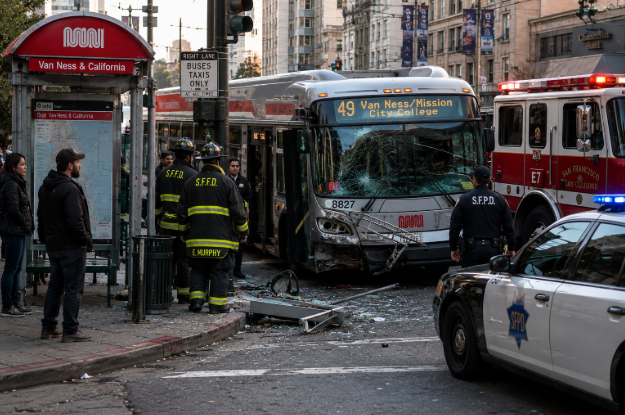
Who Can Be Held Liable in a San Francisco Bus Accident
Bus accident liability is rarely simple. Depending on how your accident happened, multiple parties may share responsibility:
- The bus driver, for reckless operation, distracted driving, or failure to yield
- The transit agency or private bus company, for negligent hiring, inadequate training, or failing to maintain vehicles
- Another driver who caused a collision with the bus
- A third-party maintenance contractor, if a mechanical failure contributed
- A government entity responsible for a dangerous roadway condition
Sorting out which parties are liable requires a thorough investigation. Bus companies and transit agencies preserve security footage, driver logs, and maintenance records for limited periods. Early legal action can make the difference between having evidence and losing it.
Common Injuries in San Francisco Bus Accidents
Buses carry dozens of passengers, and a sudden stop, collision, or rollover can throw riders with tremendous force. Common injuries include traumatic brain injuries, spinal injuries, broken bones, lacerations, and internal organ damage. Passengers who were standing when the impact occurred face the highest injury risk. Pedestrians and cyclists struck by buses often suffer catastrophic injuries requiring long-term care. According to the California Office of Traffic Safety, large vehicle collisions account for a disproportionate share of serious and fatal injuries on California roads.
If you are unsure whether your injuries are serious enough to warrant legal action, the answer is: get evaluated. Bus accident injuries often worsen over days or weeks. What feels manageable on day one can become a months-long recovery. Document everything from the first day and speak with an attorney before accepting anything from an insurer or transit authority.
California Law and Bus Accident Claims
Under California Code of Civil Procedure Section 335.1, you have two years from the date of injury to file a personal injury lawsuit. However, if your accident involved a government-owned or operated bus, that two-year clock is preempted by a much shorter administrative deadline. You must file a government claim within six months of the incident. Missing that deadline eliminates your right to sue the public entity entirely.
Bus drivers operating commercial vehicles must hold a Commercial Driver’s License and comply with hours-of-service rules designed to prevent fatigued driving. Violations of these rules can be powerful evidence of negligence. Transit agencies have a heightened duty of care toward passengers as common carriers under California law. That standard is higher than the ordinary duty owed between drivers on the road.
California’s pure comparative fault rule applies here, too. If you are found to share some responsibility, your recovery is reduced by your percentage of fault, but it is not eliminated. For example, if your case is worth $500,000 and you are found 20% at fault, you still recover $400,000. You can file a claim even if you bear partial responsibility for the accident.
What to Do After a Bus Accident in San Francisco
- Seek medical attention immediately, even if you feel fine. Some serious injuries do not produce immediate symptoms.
- Do not leave the scene without documenting it. Photograph the bus, the road, your injuries, and any relevant signage near stops or crosswalks in areas like the Mission District or near City Hall.
- Get the bus number, route, and driver information if possible.
- Collect contact information from any witnesses.
- Report the accident to the transit agency or call 911 so a police report is generated.
- Do not give a recorded statement to any insurance adjuster or transit authority representative before speaking with a lawyer.
- Call Culver Legal before the six-month government claim deadline closes your options.
Expert Legal Tip from the Attorneys at Culver Legal: One of the most common mistakes bus accident victims make is waiting to see how their injuries develop before contacting an attorney. That delay can be fatal to a claim against a public transit agency. The six-month government claims deadline does not pause while you recover. Call a lawyer within the first few days, not the first few months.

How Culver Legal Builds Your Bus Accident Case
- Free case evaluation. We review the facts, identify all liable parties, and confirm whether the six-month government claims deadline applies to your situation.
- Evidence collection and investigation. We move quickly to obtain bus surveillance footage, driver logs, maintenance records, route data, and any available witness statements before they are lost or destroyed.
- Damage documentation with medical providers and experts. We coordinate with your medical team to document every injury, project future care costs, and establish the full scope of economic and non-economic harm.
- Insurance negotiations. We handle all communication with the transit agency’s legal team and any involved insurance carriers. You do not speak to them without us.
- Litigation and trial preparation, if needed. If a fair settlement is not reached, we prepare your case for trial. Transit agencies and bus companies know which firms go to court. We do.
Why Bus Accident Claims Are Legally Complex
Bus accident cases present challenges that straightforward car accident claims do not. First, the government claims process runs parallel to the standard litigation timeline and has its own procedures. Errors in how a government claim is filed can doom a case before it ever reaches a courtroom. Second, transit agencies are experienced defendants with dedicated legal staff. Third, fault disputes are common. Agencies may argue the driver acted appropriately, the roadway condition was not their responsibility, or that your injuries predated the accident. Fourth, multiple defendants with overlapping insurance coverage create disputes about which policy responds and in what order. These disputes are resolved through litigation, not goodwill. For more on California personal injury claims involving government entities, see the California Courts’ official website.
For more context on how the California personal injury system works across claim types, see our overview of catastrophic injury claims.
What Not to Say to Transit Authorities and Insurers
After a bus accident, you may be contacted by a transit agency representative, an insurance adjuster, or both. What you say in these conversations becomes part of the record. Avoid the following:
- “I’m fine” or “I’m not that hurt.” Injuries often worsen over days. Saying this early creates a record that contradicts your later medical findings.
- “It happened so fast, I’m not sure what I saw.” Admissions of uncertainty about the facts are used to undermine your account later.
- Agreeing to give a recorded statement. You are not required to do this without legal guidance. Recorded statements are used against claimants, not for them.
- Accepting any early settlement offer without legal review. Transit agencies sometimes offer fast, low settlements precisely because they know the full value of your injuries has not yet emerged.
Why Choose Culver Legal for Your San Francisco Bus Accident Case
Culver Legal has recovered $200 Million and counting for injured clients across California. Our results include a $4 million auto accident settlement, a $3.7 million personal injury recovery, and a $3 million truck accident result. Our attorneys Thanos Simoudis, David Merabi, Dario C. Gomez, Victoria Manesh, Michael Domingo, and Michael B. Huynh handle complex cases involving transit agencies, commercial carriers, and government defendants. We are available 24 hours a day, seven days a week. We are bilingual in English and Spanish. And we charge no fees unless we win your case. Your first consultation is free.
What to Bring to Your First Consultation
You do not need to have everything organized before you call. Bring what you have:
- Medical records, bills, and any treatment summaries
- Photos or videos of the scene, the bus, and your injuries
- The police or incident report, or just the report number
- Your insurance information
- Any documentation of lost income
If you do not have these items yet, do not wait. Culver Legal can help gather records. The most important step is calling early so your legal options stay open.
Evidence Checklist: What You Need to Support Your Bus Accident Claim
- Bus number, route, and operator information
- Police or transit authority incident report
- Bus surveillance footage (request preservation immediately)
- Driver logs and hours-of-service records
- Bus maintenance and inspection records
- Photographs of the scene, bus, road conditions, and your injuries
- Witness names and contact information
- Medical records documenting all injuries from first visit forward
- Proof of lost wages or income disruption
- Any prior complaints or violation records involving the bus or driver
What to Look for When Hiring a Bus Accident Lawyer
Government claims experience: Ask whether the attorney has filed claims against public transit agencies before. The administrative process is distinct from standard litigation. You want someone who knows it.
Trial readiness: Transit agencies and their insurers settle more readily when they know the opposing firm tries cases. Ask whether the attorney has taken similar cases to verdict.
Timeline awareness: Your attorney should flag the six-month government claims deadline in the first conversation. If they do not, that is a problem.
Communication: Ask how often you will receive updates and who specifically handles your case. You should have direct access to your attorney, not only a case manager.
Fee structure: Contingency-only means no upfront cost and no fee unless you recover. Verify that all costs, including litigation expenses, are clearly explained before you sign.
Culver Legal operates on a contingency fee with no upfront cost. Our attorneys handle complex multi-party claims,s including those against public transit agencies. We are available around the clock and have the verdicts and settlements to show what we do when cases go to court.
Can I Still File if I Am Undocumented?
Yes. California law prohibits the use of immigration status in personal injury proceedings. Your status does not affect your right to file a claim or recover compensation. Culver Legal represents clients regardless of immigration status.
What If I Was Partially at Fault?
California’s pure comparative fault rule means partial fault does not bar your recovery. If your case is worth $500,000 and you are found 30% at fault, you still recover $350,000. You can file even if you are 99% at fault. Your recovery is reduced, not eliminated.
What If I Were Injured on the Job While on a Bus?
If you were traveling for work when the bus accident happened, you may have both a workers’ compensation claim and a civil lawsuit. These are separate legal tracks and do not cancel each other out. Culver Legal can advise you on both options at your free consultation.
Frequently Asked Questions: Bus Accident Claims in San Francisco
Local Resources for Bus Accident Victims in San Francisco
We do not endorse these organizations or profit from listing them.
- UCSF Medical Center – 500 Parnassus Ave, San Francisco, CA 94143
- Zuckerberg San Francisco General Hospital and Trauma Center – 1001 Potrero Ave, San Francisco, CA 94110
- St. Mary’s Medical Center – 450 Stanyan St, San Francisco, CA 94117
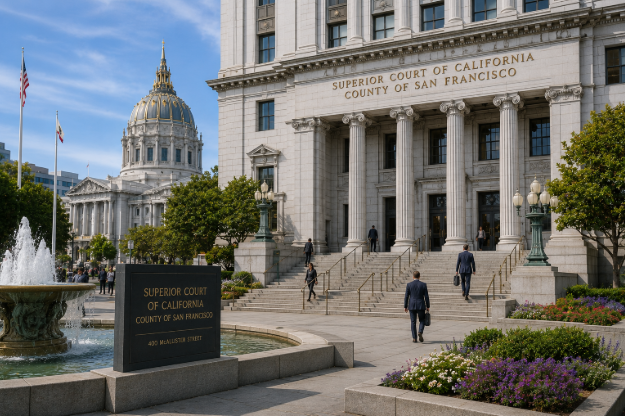
- San Francisco Superior Court (Civic Center Courthouse) – 400 McAllister St, San Francisco, CA 94102
Serving Clients Throughout San Francisco and Northern California
Culver Legal represents bus accident victims across San Francisco, including clients from the Mission District, the Sunset, the Tenderloin, SoMa, and the Castro. We also serve clients in Oakland, Berkeley, Daly City, South San Francisco, and across the broader Bay Area and Northern California.
Culver Legal, LLP
If you or someone you love was injured in a San Francisco bus accident, the decisions you make in the days after the crash will shape what you can recover. Culver Legal fights for injured clients across California and has recovered $200 Million and counting in results. Call now for your free case evaluation. (310) 600-7881
This content has been reviewed by the attorneys at Culver Legal, LLP, licensed to practice law in the State of California.
Attorney advertising. Prior results do not guarantee a similar outcome.