Construction sites across San Francisco injure workers and bystanders every day. Whether you were working on a scaffold in SoMa, struck by equipment near the Transbay Terminal, or hurt on a residential build in the Sunset District, you have legal rights that most employers and insurers do not want you to know about. A serious construction accident does not just mean medical bills. It can mean months off work, permanent disability, and a lifetime of complications that the initial emergency room visit never captured.
California construction accident claims are legally complex. Multiple contractors, subcontractors, equipment manufacturers, and property owners are often all present on the same site. Liability does not always land where you expect. Acting fast to preserve site conditions, equipment, and records is the difference between a full recovery and a fraction of what your case is worth.
According to the U.S. Bureau of Labor Statistics, construction accounts for roughly 20 percent of all worker fatality deaths in the United States each year, making it consistently the deadliest industry by raw numbers. In California, the Division of Occupational Safety and Health (Cal/OSHA) enforces construction safety standards, but citations issued after an accident do not automatically compensate you. You need to file a separate civil claim to recover what you lost.
Culver Legal, LLP represents injured construction workers and third-party accident victims throughout San Francisco. The firm has recovered $200 Million and counting for clients across California, including $4 million in an auto accident case and $3 million in a truck accident matter. Construction site injuries often exceed those figures when long-term disability and future medical costs are properly documented. If you or someone you love was hurt on a San Francisco job site, Get Your Free Case Evaluation.
Who Can File a Construction Accident Claim in California
Injured workers often believe workers’ compensation is their only option. That is frequently wrong. Workers’ comp applies when your employer’s negligence caused the injury. But construction sites involve many parties beyond your direct employer. If a subcontractor’s crew created an unsafe condition, if a property owner failed to maintain the site, or if defective equipment caused your injury, you may have a civil third-party lawsuit on top of your workers’ comp claim. These two claims run simultaneously. One does not cancel the other.
Third-party liability cases can recover damages that workers’ compensation does not pay, including pain and suffering, full lost earning capacity, and loss of consortium. For catastrophic injuries, these categories alone can amount to far more than the workers’ comp benefit ceiling. California personal injury law treats construction accidents as civil tort claims when third-party negligence is involved. Understanding whether your case has third-party exposure requires an attorney to review site ownership records, contracts, and subcontractor agreements.
What to Do After a Construction Accident in San Francisco
- Get emergency medical care immediately. Do not minimize symptoms at the scene. Document every complaint to the treating provider. Delayed or understated injuries are used by insurers to argue the accident was not serious.
- Report the accident in writing. Notify your employer or the general contractor in writing the same day. Verbal reports disappear. A written record creates a timestamp that cannot be disputed.
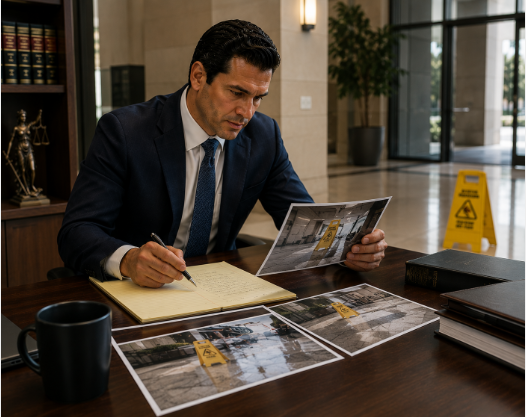
- Photograph the site before anything is moved. Scaffolding, tools, equipment positions, warning signs (or their absence), and ground conditions change fast. Get photos and video from every angle while conditions still exist.
- Identify every witness. Collect names, trade company affiliations, and phone numbers of anyone who saw the accident or was working nearby. Crews rotate on large sites, and witnesses become unreachable quickly.
- Preserve your equipment and PPE. Do not repair or replace any gear involved in the accident. Hard hats, harnesses, boots, and tools are physical evidence of equipment failure or inadequate safety provisions.
- Request the incident report. Ask the general contractor or site safety officer for a copy of any written incident report. You have a right to this document.
- Do not give a recorded statement. To any insurer, any adjustor, or any representative of a contractor or property owner. You are not required to. Statements made before you understand the full scope of your injuries and liability can severely limit your recovery.
- Contact a San Francisco construction accident attorney as soon as possible. Evidence on active construction sites is cleared rapidly. The sooner an attorney can issue preservation letters and begin an independent investigation, the stronger your case.
Expert Legal Tip from the Attorneys at Culver Legal: One of the most overlooked evidence preservation steps after a construction accident is requesting site safety inspection records and OSHA compliance logs before they are updated or destroyed. Cal/OSHA citations, if issued, are public record. But the site’s internal safety inspection logs, toolbox talk records, and training documentation are not. An attorney can send a litigation hold letter within days of the accident to freeze these records before they are overwritten or shredded. Waiting even two weeks can make this information permanently unavailable.
What NOT to Do After a Construction Accident
- Do not post about the accident on social media. Photos, check-ins, and comments about your physical activity are monitored by defense investigators and used to contradict injury claims.
- Do not accept early settlement offers. Insurers for contractors and property owners make early offers before the full extent of injuries and long-term costs are known. Signing releases any future claims permanently.
- Do not miss medical appointments. A gap in treatment is used to argue that you recovered or that your ongoing symptoms are unrelated to the accident.
- Do not assume workers’ comp is your only avenue. Many construction accident victims have viable third-party claims they never pursued because no one told them.
- Do not speak with other parties’ attorneys without your own attorney present.
Why Construction Accident Cases Are Legally Complex
A typical San Francisco construction site may have a property developer, a general contractor, a dozen or more subcontractors, equipment rental companies, and materials suppliers all operating simultaneously. Each party carries separate insurance. Each will argue that another party is responsible for your injury. Determining the correct defendants, the correct insurance policies, and the correct legal theories requires a thorough investigation before a single demand letter goes out.
OSHA violations are a central element of most construction accident claims. When Cal/OSHA cites a contractor for a violation related to your injury, that citation is powerful evidence of negligence. But it is not automatic proof of liability in a civil case. Defense attorneys will argue that a citation does not establish causation, or that your own conduct contributed to the accident. California’s pure comparative fault system applies here as well: even if you are found partially at fault, you can still recover. Your recovery is reduced by your share of fault, not eliminated.
Equipment defects add another layer. If a power tool, scaffold component, crane part, or safety harness failed, the manufacturer may be liable under product liability theories entirely separate from site negligence. Identifying and preserving the defective equipment for expert analysis is critical and time-sensitive.
California also imposes specific recordkeeping obligations on contractors and employers. Under Cal/OSHA regulations, employers must report serious injuries and fatalities within specific timeframes. Accessing those reports, as well as electronic logging data, equipment maintenance records, and subcontractor safety certifications, requires legal authority. An attorney can obtain these through formal discovery or litigation hold demands. Acting without one often means these records are gone before a claim is filed.
California Laws That Apply to Your Construction Accident Claim
Under California Code of Civil Procedure Section 335.1, you have two years from the date of injury to file a personal injury lawsuit. If the property owner or contractor is a government entity, such as the City and County of San Francisco or a public transit authority, a separate administrative claim must be filed within six months of the incident. Missing either deadline eliminates your claim.
California Labor Code Section 3852 confirms that an injured worker’s right to pursue a civil claim against a third party is not waived by filing for workers’ compensation. Both tracks can run simultaneously. If you recover in a civil lawsuit, your workers’ compensation insurer may have a right of subrogation, meaning they can recover some of what they paid you from your civil settlement. An attorney structures settlements to minimize the subrogation impact and protect the maximum net amount in your hands.
Cal/OSHA enforces Title 8 of the California Code of Regulations, which contains specific construction safety standards covering scaffolding, fall protection, excavation, electrical hazards, and heavy equipment operation. When a contractor’s violation of these standards causes injury, it is strong evidence of negligence. For information on current Cal/OSHA construction safety requirements, visit the California Department of Industrial Relations, Division of Occupational Safety and Health.
California is a pure comparative fault state. If you were found 20 percent at fault for a construction accident worth $500,000 in damages, you would still recover $400,000. Insurers argue contributory fault aggressively in construction cases, claiming you failed to follow safety protocols or entered a restricted area. These arguments do not eliminate your claim. They reduce it, and a skilled attorney contests them with site evidence, training records, and witness testimony.
What Compensation Can You Recover
Construction accident damages in California can include:
- All current and future medical expenses, including surgeries, rehabilitation, assistive devices, and long-term care
- Lost wages and lost earning capacity if your injuries prevent you from returning to your trade
- Pain and suffering, including physical pain and emotional distress
- Permanent disability and disfigurement
- Loss of consortium for your spouse or domestic partner
- Punitive damages in cases of egregious or willful safety violations by an employer or contractor
For severe injuries such as spinal cord damage, traumatic brain injuries, crush injuries, or amputations, damages routinely extend into the millions when future care costs are properly projected by a life care planning expert. Vocational assessments document the income you will lose if you cannot return to construction work or must take a lower-paying position. These expert analyses are required to present a full damages case to a jury or an insurer in negotiations.
Culver Legal works with San Francisco-area medical specialists and forensic economists to build complete damages documentation. If your injury is catastrophic, the gap between what an insurer initially offers and what your case is actually worth can be several million dollars. That gap is what the firm fights to close. For a full review of what your San Francisco personal injury claim may be worth, contact the team today.
How We Build Your Construction Accident Case
- Free case evaluation. Culver Legal reviews your accident details, identifies all potential defendants, and explains the third-party versus workers’ comp strategy that applies to your situation. No charge, no obligation.
- Evidence collection and investigation. The firm issues litigation hold letters to preserve site records, obtains Cal/OSHA investigation files, secures surveillance footage from nearby cameras, and retains an independent site safety expert to document conditions. Time pressure here is real.
- Damage documentation with medical providers and experts. Culver Legal coordinates with your treating physicians to document the full medical picture, brings in life care planners for catastrophic injuries, and retains vocational experts to project lost earning capacity. Future costs are calculated before any settlement figure is discussed.
- Insurance negotiations. Multiple insurers are typically involved in construction accident claims. The firm identifies all applicable policies, submits demand packages supported by expert reports, and negotiates for the full value of the claim across every coverage tier.
- Litigation and trial preparation, if needed. Culver Legal prepares every case as if it will go to trial. When insurers refuse to pay full value, the firm files suit and takes the case through to verdict. The firm’s track record of results, including settlements over $3 million, reflects the credibility that comes from genuine trial readiness.
What to Bring to Your First Consultation
You do not need to have everything organized before calling. Whatever you have is a starting point. The most important step is calling early, before the evidence disappears.
Helpful items to bring or have available:
- Medical records, ER reports, and any bills received so far
- Photos or video of the accident site, your injuries, or the equipment involved
- The incident report filed by your employer, the general contractor, or the report number, if you have it
- Any workers’ compensation claim documentation you have filed or received
- Insurance information for your employer, the general contractor, or any other parties you are aware of
- Pay stubs or proof of your wage rate if you have missed work
If you do not have these items, that is not a problem. Culver Legal can help gather records, obtain official reports, and build the evidentiary record from the beginning. The critical step is calling before records are destroyed and deadlines pass.
What to Look for When Hiring a Construction Accident Lawyer
Construction and Third-Party Liability Experience
- Has the attorney handled cases involving multiple contractors and subcontractors on a single site?
- Does the firm understand Cal/OSHA regulations and how violations support civil negligence claims?
- Has the attorney pursued simultaneous workers’ comp and civil third-party claims?
Trial Readiness
- Does the firm litigate cases through trial, or does it primarily settle early?
- Can the attorney point to verdicts and settlements in construction accident cases specifically?
- Does the firm retain qualified experts, including life care planners and forensic economists, for catastrophic injury cases?
Local Court Familiarity
- Is the attorney familiar with San Francisco Superior Court procedures and local judicial expectations?
- Does the firm have experience with claims against San Francisco city contractors or public entities requiring the six-month administrative deadline?
Communication and Accessibility
- Will you have direct access to the attorney handling your case, or will you deal primarily with paralegals?
- Is the firm available outside business hours if you have urgent questions?
Fee Structure
- Does the firm work on a contingency fee basis with no upfront costs?
- Are costs explained clearly in the retainer agreement?
Culver Legal operates on a contingency fee basis. No fees unless the firm wins. The firm is available 24/7, bilingual in English and Spanish, and backed by a record of $200 Million recovered for clients. Attorneys Thanos Simoudis, David Merabi, Dario C. Gomez, Victoria Manesh, Michael Domingo, and Michael B. Huynh bring combined courtroom experience across California’s most complex personal injury matters.
Evidence Checklist: What You Need to Support Your Construction Accident Claim
- Photographs and video of the accident site were taken immediately after the incident, before conditions changed.
- Photos of all equipment involved, including serial numbers and manufacturer labels
- The written incident report from your employer or general contractor
- Cal/OSHA investigation report and any citations issued
- Safety inspection logs and toolbox talk records for the job site
- Subcontractor agreements and site safety plans identifying responsible parties
- Driver qualification files and training records for any heavy equipment operators involved
- Maintenance and repair logs for any equipment that failed or contributed to the injury
- Witness names, contact information, and trade company affiliations
- All medical records and treatment documentation from the date of injury forward
- Workers’ compensation claim records and correspondence
- Pay stubs, tax returns, or contractor invoices documenting pre-accident income
- Your personal protective equipment was in the condition it was in at the time of the accident
Why Choose Culver Legal for Your San Francisco Construction Accident Case
- $200 Million recovered for clients across California
- Settlements including $4M auto accident, $3.7M personal injury, $3.55M auto accident, $3M truck accident, $2.5M commercial accident, and $2.25M motorcycle accident
- No fees unless we win
- Free case evaluation
- Available 24/7
- Bilingual: English and Spanish (Hablamos Español)
- Attorneys: Thanos Simoudis, David Merabi, Dario C. Gomez, Victoria Manesh, Michael Domingo, Michael B. Huynh
San Francisco Construction Accident: Common Questions
Local Resources for Construction Accident Victims in San Francisco
The following local resources may assist you after a construction accident. We do not endorse these organizations or profit from listing them.
Hospitals and Trauma Centers
- Zuckerberg San Francisco General Hospital and Trauma Center, 1001 Potrero Ave, San Francisco, CA 94110 (Level I Trauma Center)
- UCSF Medical Center at Parnassus, 505 Parnassus Ave, San Francisco, CA 94143
- St. Mary’s Medical Center, 450 Stanyan St, San Francisco, CA 94117
- Kaiser Permanente San Francisco Medical Center, 2425 Geary Blvd, San Francisco, CA 94115
Courthouse
- San Francisco Superior Court, 400 McAllister St, San Francisco, CA 94102
Regulatory Authority
- Cal/OSHA San Francisco District Office, 455 Golden Gate Ave, Suite 9516, San Francisco, CA 94102
Serving Clients Across San Francisco and Surrounding Communities
Culver Legal represents construction accident victims throughout San Francisco and the surrounding Bay Area, including Oakland, Daly City, South San Francisco, Berkeley, San Mateo, and Alameda. The firm handles cases statewide across California.
Contact a San Francisco Construction Accident Lawyer Today
Construction site injuries move fast toward permanent consequences. Evidence disappears. Records get updated. Legal deadlines run. Culver Legal is available 24 hours a day, seven days a week, to evaluate your case at no cost and no obligation. The firm works on contingency. You pay nothing unless we win. Call Culver Legal at Call Now (310) 600-7881.
Culver Legal, LLP
5670 Wilshire Blvd., Suite 1370
Los Angeles, CA 90036
(310) 600-7881
Serving San Francisco and all of California.
This content has been reviewed by the attorneys at Culver Legal, LLP, licensed to practice law in the State of California.
Attorney Advertising. Prior results do not guarantee a similar outcome.