If you ride here, the numbers are not on your side, and they are worse than most riders realize.
San Diego County ranks first of all 58 California counties for motorcycle riders killed or injured. Not near the top. First. The California Office of Traffic Safety recorded 1,693 motorcycle victims killed or injured across the county in 2023, and within the city itself motorcycles rank 4th of the fifteen California cities over 250,000, at 349 victims.
That is the environment your claim is made in, and it shapes how an insurer will treat you.
Culver Legal, LLP represents injured riders throughout San Diego County. We work on contingency and advance the costs of the case, so there is nothing to pay up front and no fee unless we win. If there is no recovery, you are not charged those costs either. Call (310) 600-7881 at any hour.
What California Law Actually Says About Lane Splitting
This gets stated wrongly almost everywhere, including by people who should know better, and the mistake can cost you.
California law does not declare lane splitting legal. Vehicle Code 21658.1 does two things: it defines lane splitting as riding “between rows of stopped or moving vehicles in the same lane”, and it authorizes the California Highway Patrol to develop educational guidelines about it. It contains no language permitting it and none prohibiting it.
What follows from that is the practical part. Because the statute sets no standard of its own, whether your lane splitting was reasonable is judged the way any other driving is judged: against ordinary care in the conditions. Speed differential, traffic, lane width, weather and visibility all come into it.
So an insurer cannot end your claim by saying lane splitting is illegal, and you cannot win it by saying the law allows it. Both are the wrong argument. The question is always whether the riding was reasonable, and that is a factual dispute you can win with evidence.
Anyone who tells you a statute says lane splitting is legal “when done safely” is describing a standard the law does not contain.
Has an insurer told you lane splitting ends your claim?
No statute says that. It is a question of reasonable care, and that is arguable.
Being Partly at Fault Does Not End It
California is a pure comparative fault state. If you are found partly responsible, your recovery is reduced by that percentage rather than eliminated. A rider found 30% at fault still recovers 70%.
This matters more for motorcyclists than for anyone else on the road, because the arguments made against riders are so predictable: you were splitting lanes, you were going too fast, the driver did not see you. The last one is not a defense at all. A driver’s duty includes looking for motorcycles, and “I never saw the bike” is an admission far more often than it is an excuse. The same fault rules apply to any car accident claim; what changes on a bike is how readily the blame is assumed.
The helmet question, answered properly
Vehicle Code 27803 requires that “a driver and any passenger shall wear a safety helmet”. California’s requirement covers everyone, at every age, unlike many states.
If you were not wearing one, you still have a claim. What it can do is reduce recovery for head and neck injuries specifically, through comparative fault, and it has no bearing at all on a broken leg or a shoulder injury. Insurers routinely try to apply it to the whole claim. It does not work that way.
What You Do in the First Week Decides a Lot of It
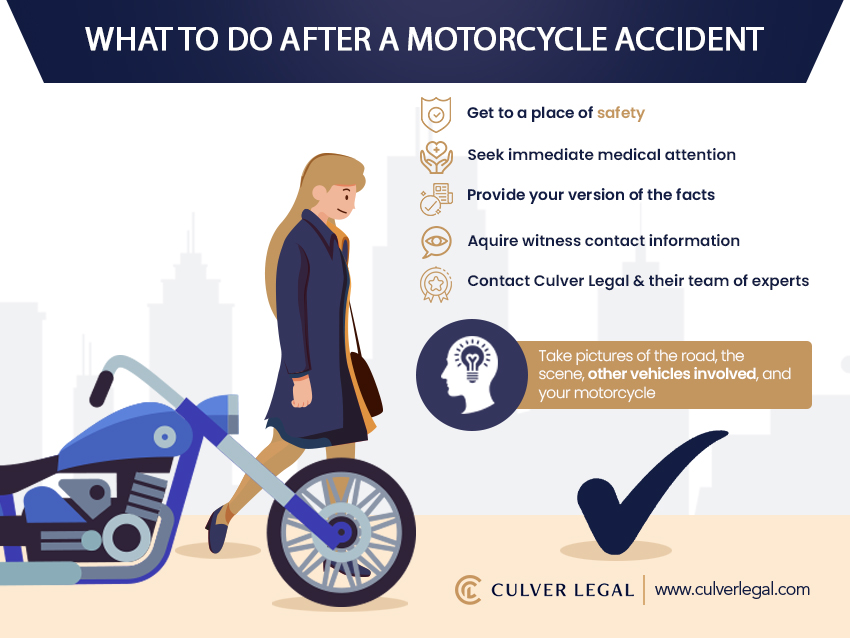
- Get medical attention the same day, even if you walked away. Adrenaline hides a great deal, and a head injury can declare itself over the following week.
- Photograph the bike before it is repaired or scrapped. The damage pattern is evidence about speed and angle, and it disappears the moment the bike is fixed.
- Keep the gear. A scraped helmet, torn leathers and damaged boots show what happened to your body better than any description of it.
- Get names from witnesses at the scene, who scatter within minutes.
- Do not give a recorded statement to any insurer before taking advice.
- Do not accept an early offer. It arrives before the medical picture is complete, which is the point of it.
The gap that costs more than any argument
A break in treatment is the single most effective thing an insurer has against you, and it is usually self-inflicted rather than deserved.
If you stop attending appointments for a few weeks, whether because you feel slightly better, the copays mount up or life gets in the way, the file shows a gap. That gap gets read back later as evidence you had recovered, and every symptom afterwards gets attributed to something else.
If you need to pause treatment, say why in writing to the provider, so the reason is in the record rather than inferred from silence.
Were You Working When It Happened?
If you were riding for work, on a delivery, or between job sites, there are usually two claims rather than one.
Workers’ compensation covers treatment and part of your lost wages regardless of fault, and it pays nothing for pain and suffering. A work injury claim runs alongside a civil claim against whoever actually caused the crash, and the civil claim is where the larger part of the recovery usually sits.
Where a rider was killed, the claim belongs to the family under a separate statute, and that is a wrongful death claim rather than a continuation of the injury claim.
Where You Were Treated Was Decided Before You Arrived
San Diego runs a catchment area trauma system. The county is divided into geographic zones, and each zone is assigned to a specific trauma center. You were taken to the center for where the crash happened, not to the nearest hospital and not to one anyone chose.
The county’s adult Level I centers are Scripps Mercy Hospital San Diego and UC San Diego Medical Center, with Rady Children’s Hospital as the pediatric Level I.
That is worth knowing for a practical reason. One hospital holds your imaging, your trauma activation record and the first responder narrative, and which one it is was determined by geography. On a serious motorcycle injury those records are the backbone of the claim, and they are easier to get early than late.
Getting the Collision Report
For a crash on a city street inside San Diego, the report comes from the San Diego Police Department, and there are three things worth knowing before you try.
- It costs $12.
- Allow three to ten business days from the date of the crash before requesting it, so the report can be submitted, processed and approved for release.
- After seven business days you can confirm it is ready on (619) 531-2846.
- Reports are not faxed or emailed. They are collected in person or sent by mail. Somebody else can collect yours with written authorization, photo ID and the fee.
A crash on Interstate 5, Interstate 8, Interstate 15 or Interstate 805 is normally the California Highway Patrol’s rather than the city’s.
If a Public Entity Is Involved, the Deadline Is Six Months
This is the deadline that ends motorcycle claims that had nothing wrong with them, and on a bike it comes up more than people expect, because road surface defects that a car would shrug off will put a motorcycle down.
Where a public entity is a defendant, a written claim must be presented within six months under Government Code 911.2, rather than the ordinary two years, and no lawsuit can be filed until it has been.
Establish which entity, because they are not interchangeable.
- The City of San Diego. Claims go to the Risk Management Department at **1200 Third Ave., Suite 1000, on the city’s own RM-9 form. Since 11 December 2023 the city no longer accepts first-notice claims by email.** It is the online portal, mail, or in person. Emailing one may mean it was never presented.
- San Diego MTS. The Metropolitan Transit System is **a California public agency in its own right**, and its own board policy requires claims against it and its subsidiaries, the bus company and the trolley company, to comply with the Government Claims Act. **A claim against MTS goes to MTS at 1255 Imperial Avenue, not to the city.**
- Caltrans, the county, or another city, depending on who controlled the road.
A claim presented to the wrong entity has not been presented at all. Where you are unsure, work to the six months.
How Long Do You Have Otherwise?
Two years from the date of injury under Code of Civil Procedure 335.1.
A motorcycle claim seeking more than $35,000 is an unlimited civil case, filed at the Hall of Justice, 330 West Broadway, which houses the Superior Court’s civil courtrooms, and heard in San Diego County before a San Diego County jury.
Did the road surface put you down?
That is a six-month deadline, not two years. And it goes to the entity that controlled the road.
Why Do San Diego Riders Choose Culver Legal?
We treat the bias as the first problem, not an afterthought. Riders are blamed by default, and a claim run without anticipating that concedes ground before anyone reads the file.
Our team speaks Spanish, Farsi, Filipino, Hindi, Mandarin and Korean.
The economics are simple. Contingency, costs advanced, nothing up front and no fee unless we win. We advance the case costs, and if there is no recovery you are not charged those costs either. Culver Legal has recovered $200 Million and counting, and the phone is answered 24 hours a day.
San Diego Motorcycle Accident FAQs
What is the average settlement for a motorcycle accident in California?
There is no honest average, and any figure quoted as one should make you cautious rather than reassured. Motorcycle claims range from a few thousand dollars to catastrophic-injury cases, and the outcome turns on the medical picture, the available insurance and the fault split. An average across that range describes no real case. What can be said usefully early is which policies might respond and what the deadline is, and both of those are answerable in one conversation.
Should I get a lawyer after a motorcycle accident?
For a minor incident with no injury, often not. Where there is a real injury, the argument for it is specific rather than general: riders face a default assumption of blame, the evidence that rebuts it is time-limited, and the six-month deadline for a claim against a public entity is easy to miss entirely. A review costs nothing and tells you whether it is worth pursuing at all.
Is lane splitting legal in California?
Not in the way people mean. California law defines lane splitting and directs the Highway Patrol to publish educational guidelines, but no statute declares it legal or illegal. What that means in practice is that your riding is judged against ordinary care in the conditions, like any other driving. An insurer cannot end your claim by calling it unlawful, and no statute blesses it as safe.
How much do accident attorneys charge in California?
These cases are handled on contingency, so the fee is a percentage of what is recovered and there is no fee if there is no recovery. Case costs are advanced rather than billed to you as they arise. What we will not do is quote a percentage as though it were the only number that matters, or put a value on your claim before we know how the injury settles.
I was not wearing a helmet. Is my claim over?
No. California requires a helmet for the driver and any passenger, and riding without one can reduce recovery through comparative fault, but it does not bar a claim. The reduction should apply only to injuries a helmet would have affected, which means head and neck. It has no bearing on a broken leg, a shoulder or road rash, and insurers routinely try to stretch it across the whole claim anyway.
I am undocumented. Can I bring a claim without putting myself at risk?
Yes, and the protection is stronger than most people expect. Under Evidence Code 351.2, added by AB 2159, evidence of a person’s immigration status is not admissible in a civil action for personal injury or wrongful death, and discovery into it is not permitted either. It cannot be raised at trial and it cannot be asked about beforehand. It is not a question we ask you, and it is not a question the other side gets to ask.
Contact a Culver Legal San Diego Motorcycle Accident Lawyer
San Diego County is the worst county in California for motorcycle riders killed or injured, and the evidence that decides these claims has a short life. If you were hurt riding anywhere in the county, reach us at (310) 600-7881 at any hour. The review costs nothing.
Attorney Advertising. Prior results do not guarantee a similar outcome. Culver Legal, LLP is a California law firm. The information on this page is for general informational purposes and does not constitute legal advice.