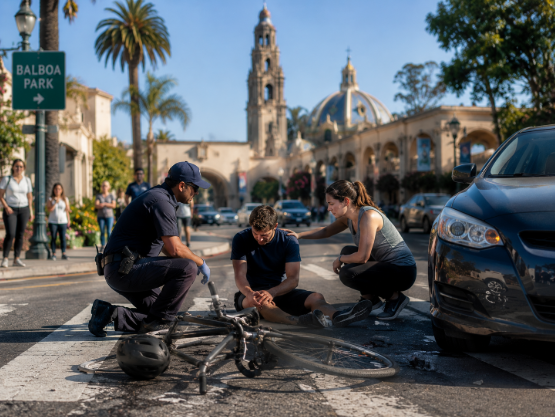
Something changed for children on bikes in this city, and it changed fast.
Cyclists under 15 killed or injured in San Diego rose from 26 to 37 in a single year, moving the city from 8th to 3rd worst of the fifteen California cities over 250,000. Across the city as a whole, 380 cyclists were killed or injured in 2023, and countywide the figure was 893.
Those are the California Office of Traffic Safety’s own counts, and they describe a road environment that is getting worse for the people least able to absorb it.
Culver Legal, LLP represents injured cyclists and their families across San Diego County. We work on contingency and advance the costs of the case, so there is nothing to pay up front and no fee unless we win. If there is no recovery, you are not charged those costs either. Call (310) 600-7881 at any hour.
What Are the Bicycle Laws in San Diego?
The most important one surprises people, and it is the foundation of every claim on this page.
A cyclist has the same rights on the road as a driver. Vehicle Code 21200 states that a person riding a bicycle on a highway “has all the rights and is subject to all the provisions applicable to the driver of a vehicle”, except those that by their nature cannot apply.
You are not a guest on the road. You are traffic. That cuts both ways, because it also means a cyclist is bound by the rules that apply to drivers, but it is the starting point an insurer would rather you did not know.
A driver passing you must leave three feet. Vehicle Code 21760 is formally called the Three Feet for Safety Act. A driver “shall not overtake or pass a bicycle … at a distance of less than three feet between any part of the motor vehicle and any part of the bicycle or its operator.”
And when three feet is not possible, the obligation does not disappear. Where traffic or road conditions make it impossible, the driver “shall slow to a speed that is reasonable and prudent, and may pass only when doing so would not endanger the safety of the operator of the bicycle.”
That second half is the part almost nobody quotes, and it is often the whole case in a close-pass collision. A driver who squeezed past because there was no room did not comply by trying. They were required to slow down and wait.
Were you hit by a driver squeezing past?
Three feet is the rule, and “there was no room” is not a defense. They were required to slow and wait.
Who Pays When a Bicycle and a Car Collide?
Usually the driver’s auto liability policy, and the question people ask backwards is worth answering directly.
If a cyclist is at fault for hitting a car, the cyclist can be liable for the damage, and it is often their homeowner’s or renter’s insurance that responds rather than anything to do with the bike.
If a driver is at fault for hitting a cyclist, their liability policy is primary. Two further sources are routinely missed:
- Your own auto policy. Many policies cover the holder for injuries as a pedestrian or cyclist struck by a vehicle, including uninsured and underinsured motorist coverage. You do not need to have been in your car.
- A household member’s policy, which can extend to relatives living with them.
This matters because California’s minimum liability coverage is small. A single serious cycling injury can exhaust a minimum policy before the hospital bill is settled, and at that point the question is what else responds.
Being Partly at Fault Does Not End Your Claim
California is a pure comparative fault state. If you are found partly responsible, your recovery is reduced by that percentage rather than eliminated. A cyclist found 20% at fault still recovers 80%.
Expect the arguments: you were not in the bike lane, you were not wearing a helmet, you came off the sidewalk, the driver did not see you. The last one is not a defense. A driver’s duty includes looking, and “I never saw the bike” is closer to an admission than an excuse.
On helmets specifically: California requires them only for riders under 18. For an adult, not wearing one cannot bar a claim, and any reduction should be confined to head injuries rather than applied across the whole case. Insurers try to stretch it anyway.
What You Do in the First Week
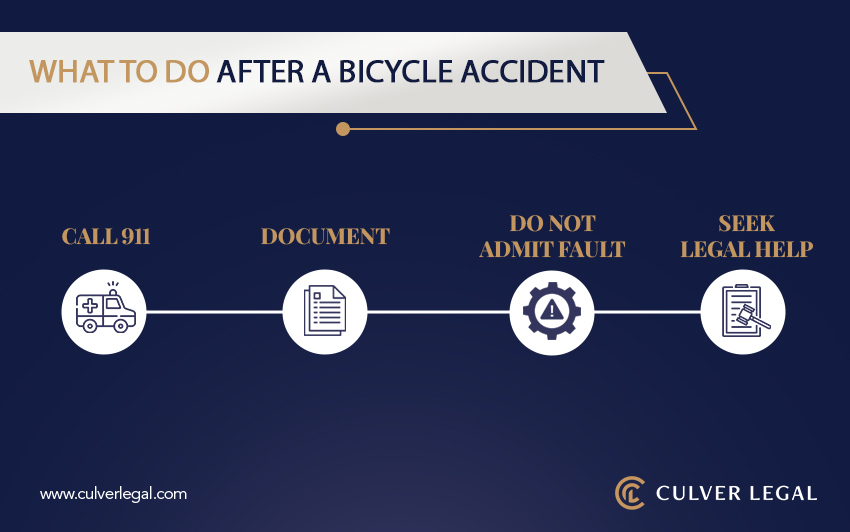
- Get medical attention the same day. A head injury can take days to declare itself, and cyclists take them more often than any other road user.
- Do not repair or discard the bike. The damage pattern is evidence about speed and angle. A bent fork or a rear-wheel strike tells a story that a description cannot.
- Keep the helmet and the clothing, damaged as they are.
- Photograph the scene, including the lane markings, any bike lane, and what the driver could see.
- Get witness names before they leave.
- Do not give a recorded statement to any insurer before taking advice.
A gap in treatment is the most effective thing an insurer has against you. If you stop attending appointments, the file shows a break, and that break is later read as evidence you had recovered. If you must pause, put the reason in writing to the provider.
Where You Were Treated Was Decided Before You Arrived
San Diego runs a catchment area trauma system. The county is split into geographic zones and each is assigned to a specific trauma center, so you were taken to the center for where the collision happened, not the closest hospital and not one anyone selected.
The adult Level I centers are Scripps Mercy Hospital San Diego and UC San Diego Medical Center, with Rady Children’s Hospital as the pediatric Level I. Given the figures at the top of this page, Rady is where a seriously injured child cyclist in this county is most likely to be taken.
One hospital therefore holds the imaging, the trauma activation record and the first responder narrative, and geography decided which.
Getting the Collision Report
For a collision on a city street inside San Diego, the report comes from the San Diego Police Department. It costs $12. Allow three to ten business days from the date of the crash before requesting it, and after seven business days you can confirm it is ready on (619) 531-2846.
Reports are not faxed or emailed. They are collected in person or sent by mail.
A collision on Interstate 5, Interstate 8, Interstate 15 or Interstate 805 is normally the California Highway Patrol’s rather than the city’s.
If the Road Itself Put You Down, the Deadline Is Six Months
This is the deadline that ends cycling claims that were otherwise sound, and it comes up far more for cyclists than for drivers, because a defect a car would never notice will put a bicycle down: a pothole, a broken edge, a raised utility cover, a grate set the wrong way.
Where a public entity is a defendant, a written claim must be presented within six months under Government Code 911.2, not the ordinary two years, and no lawsuit can be filed until it has been.
Establish which entity, because they are not interchangeable. A claim against the City of San Diego goes to its Risk Management Department at 1200 Third Ave., Suite 1000, on the city’s RM-9 form. Since 11 December 2023 the city no longer accepts first-notice claims by email, so it is the portal, mail, or in person; emailing one may mean it was never presented at all. A claim involving San Diego MTS goes to MTS instead, at 1255 Imperial Avenue, because it is a separate public agency. Roadway on the state highways sits with the state.
A claim presented to the wrong entity has not been presented. Where you are unsure, work to the six months.
How Long Do You Have Otherwise?
Two years from the date of injury under Code of Civil Procedure 335.1.
For an injured child the ordinary limitation period is paused under Code of Civil Procedure 352 while they are under 18. The six-month government claim is not paused the same way, so where a child was hurt by a road defect, an adult needs to act within months rather than years. Given how the child cyclist figures have moved in this city, that is the most consequential sentence on this page.
A claim seeking more than $35,000 is an unlimited civil case, filed at the Hall of Justice, 330 West Broadway, and heard in San Diego County before a San Diego County jury.
Was your child hurt riding?
Being a minor does not pause the six-month government deadline. If the road caused it, the clock is already running.
Why Do San Diego Cyclists Choose Culver Legal?
We start from the law, not from the apology. A cyclist has the same rights on the road as a driver, and the case is built on that rather than on persuading anyone that riding was reasonable.
Our team speaks Spanish, Farsi, Filipino, Hindi, Mandarin and Korean.
The economics are simple. Contingency, costs advanced, nothing up front and no fee unless we win. We advance the case costs, and if there is no recovery you are not charged those costs either. Culver Legal has recovered $200 Million and counting, and the phone is answered 24 hours a day.
San Diego Bicycle Accident FAQs
What are the bicycle laws in San Diego?
The two that decide most claims are both state law. Vehicle Code 21200 gives a person riding a bicycle “all the rights and is subject to all the provisions applicable to the driver of a vehicle”, so a cyclist is traffic rather than a guest on the road. Vehicle Code 21760, the Three Feet for Safety Act, prohibits a driver from passing closer than three feet, and where that is not possible requires the driver to slow to a reasonable and prudent speed and pass only when it would not endanger the cyclist. Helmets are required by state law only for riders under 18.
Who pays if a bicycle hits your car?
If the cyclist was at fault, they can be liable for the damage, and it is often their homeowner’s or renter’s policy that responds rather than anything attached to the bike. If the driver was at fault for hitting the cyclist, the driver’s auto liability policy is primary, and the cyclist’s own auto policy may also respond through uninsured or underinsured motorist coverage even though they were not in a car.
Can you sue someone for hitting you on a bike?
Yes. A collision between a vehicle and a bicycle is an ordinary negligence claim, and the cyclist’s right to be on the road is established by statute rather than being something to argue. Where a public entity’s road defect caused the fall instead, the claim exists but runs on a six-month deadline rather than two years.
How much do accident attorneys charge in California?
These are handled on contingency, so the fee is a percentage of what is recovered and there is no fee if there is no recovery, with case costs advanced rather than billed as they arise. We will not put a value on a claim before knowing how the injury settles, and any figure quoted as a typical bicycle settlement should be treated with caution, because the range is far too wide for an average to describe a real case.
What should you not say after a bike accident?
Avoid guessing and avoid apologizing reflexively. Do not estimate your speed or the car’s, do not say you are fine before you have been examined, and do not accept an adjuster’s confident account of what happened. Say what you actually know: where you were going, what you saw, what hurts. And do not give a recorded statement to any insurer before taking advice, because it will be quoted back against symptoms that had not appeared yet.
I am undocumented. Can I bring a claim without putting myself at risk?
Yes, and the protection is stronger than most people expect. Under Evidence Code 351.2, added by AB 2159, evidence of a person’s immigration status is not admissible in a civil action for personal injury or wrongful death, and discovery into it is not permitted either. It cannot be raised at trial and it cannot be asked about beforehand. It is not a question we ask you, and it is not a question the other side gets to ask.
Contact a Culver Legal San Diego Bicycle Accident Lawyer
The bike is evidence, the footage is on a loop, and if a road defect caused it the deadline is six months rather than two years. If you or your child was hurt riding anywhere in San Diego County, reach us at (310) 600-7881 at any hour. The review costs nothing.
Attorney Advertising. Prior results do not guarantee a similar outcome. Culver Legal, LLP is a California law firm. The information on this page is for general informational purposes and does not constitute legal advice.