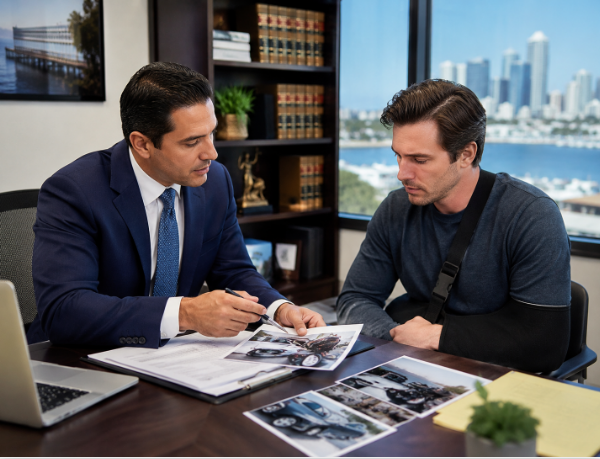
The question that decides most serious car accident claims is not who was at fault. It is how much insurance exists, and the answer is usually less than people assume.
California’s minimum liability coverage is $30,000 for injury to one person, $60,000 where more than one person is hurt, and $15,000 for property damage. Those are the Department of Motor Vehicles’ own published figures. A single ambulance ride, an emergency department admission and one surgery will pass $30,000 without difficulty.
So the useful early question is not what your claim is worth. It is what is available to pay it, and that is answerable in the first week.
Culver Legal, LLP represents injured drivers and passengers across San Diego County. We work on contingency and advance the costs of the case, so there is nothing to pay up front and no fee unless we win. If there is no recovery, you are not charged those costs either. Call (310) 600-7881 at any hour.
What Responds When the At-Fault Policy Runs Out
More than most people realize, and this is where claims are quietly lost by not asking.
- Your own uninsured and underinsured motorist coverage. This is the most important one. UIM pays the gap where the at-fault driver’s policy is too small, and most people who have it do not know they do. Check your declarations page rather than your memory of buying the policy.
- A household member’s policy, which can extend to relatives living with you.
- A second at-fault party. Multi-vehicle collisions frequently have more than one negligent driver, and each brings a separate policy.
- An employer’s policy, where the at-fault driver was working. A driver on the clock usually brings commercial coverage far larger than a personal policy, and a truck or delivery vehicle almost always does.
- Medical payments coverage on your own policy, which pays regardless of fault.
Identifying every available policy changes the outcome far more than arguing about how the crash happened. It is also time-sensitive, because the smaller the policy the faster an insurer wants to settle it.
Offered the policy limit already?
A fast limits offer usually means the policy is small. Find out what else responds before you accept it.
Being Partly at Fault Does Not End Your Claim
California is a pure comparative fault state. If you are found partly responsible, your recovery is reduced by that percentage rather than eliminated. A driver found 30% at fault still recovers 70%.
That is worth knowing because insurers open with fault arguments precisely to make people assume they have no claim. Percentages are negotiable and they are evidence-driven.
What You Do in the First Week
- Get medical attention the same day, even if you feel able to walk away. A head injury can take days to declare itself, and soft tissue injuries almost always feel worse on day three than on day one.
- Photograph everything before the vehicles are moved or repaired: positions, damage, debris, skid marks, signals and signage.
- Get witness names at the scene.
- Check your own declarations page for uninsured and underinsured motorist coverage.
- Do not give a recorded statement to the other driver’s insurer before taking advice.
- Do not accept an early offer. It arrives before the medical picture is complete, which is the point of it.
A gap in treatment is the most effective thing an insurer has against you. If you stop attending appointments, the file shows a break, and that break is later read as evidence you had recovered. If you must pause, put the reason in writing to the provider.
Where You Were Treated Was Decided Before You Arrived
San Diego runs a catchment area trauma system. The county is divided into geographic zones, each assigned to a specific trauma center, so you were taken to the center for where the crash happened, not the nearest hospital and not one anyone chose.
The adult Level I centers are Scripps Mercy Hospital San Diego and UC San Diego Medical Center, with Rady Children’s Hospital as the pediatric Level I. One of them holds your imaging, the trauma activation record and the first responder narrative, and geography decided which.
Getting the Collision Report
For a crash on a city street inside San Diego, the report comes from the San Diego Police Department. It costs $12. Allow three to ten business days from the date of the crash before requesting it, and after seven business days you can confirm it is ready on (619) 531-2846.
Reports are not faxed or emailed. They are collected in person or sent by mail.
A crash on Interstate 5, Interstate 8, Interstate 15 or Interstate 805 is normally the California Highway Patrol’s rather than the city’s, and that is a different request entirely.
If the other driver left
San Diego recorded 533 hit and run fatal and injury crashes in 2023 across all road users, so it is not unusual. The claim usually proceeds through uninsured motorist coverage on your own policy or a household member’s, and the report and any nearby camera footage matter more than usual. Footage sits on a retention loop, so the preservation request has to go out early.
If a Public Entity Is Involved, the Deadline Is Six Months
Where a public entity is a defendant, whether because a city vehicle was involved or because the road itself contributed, a written claim must be presented within six months under Government Code 911.2, rather than the ordinary two years, and no lawsuit can be filed until it has been.
A claim against the City of San Diego goes to its Risk Management Department at 1200 Third Ave., Suite 1000, on the city’s RM-9 form. Since 11 December 2023 the city no longer accepts first-notice claims by email, so it is the portal, mail, or in person. Emailing one may mean it was never presented. Where San Diego MTS is involved, the claim goes to MTS at 1255 Imperial Avenue instead, because it is a separate public agency. State highways sit with the state.
A claim presented to the wrong entity has not been presented. Where you are unsure, work to the six months.
How Long Do You Have Otherwise?
Two years from the date of injury under Code of Civil Procedure 335.1.
A claim seeking more than $35,000 is an unlimited civil case, filed at the Hall of Justice, 330 West Broadway, and heard in San Diego County before a San Diego County jury. Where someone was killed, the claim belongs to the family under a separate statute and is a wrongful death claim.
Was a city vehicle or the road itself involved?
Six months, not two years, and the city stopped taking claims by email. Do not lose it on procedure.
Why Do San Diego Drivers Choose Culver Legal?
We establish what insurance exists before arguing about anything else, because that is what determines whether a claim is worth pursuing and how.
Our team speaks Spanish, Farsi, Filipino, Hindi, Mandarin and Korean.
The economics are simple. Contingency, costs advanced, nothing up front and no fee unless we win. We advance the case costs, and if there is no recovery you are not charged those costs either. Culver Legal has recovered $200 Million and counting, and the phone is answered 24 hours a day.
San Diego Car Accident FAQs
How long do most car accident settlements take?
Longer than people hope, and the main driver is medical rather than legal. A claim should not be settled until the treating doctors can say where you have ended up, because settling before that means guessing at your own future and being wrong at your own expense. A straightforward claim with a short course of treatment can resolve in months. One involving surgery, or a disputed liability picture, or a policy limits problem, takes considerably longer. Anyone promising a fast settlement is describing a small one.
How much does a car accident lawyer cost in California?
These are handled on contingency, so the fee is a percentage of what is recovered and there is no fee if there is no recovery, with case costs advanced rather than billed as they arise. What we will not do is put a value on a claim before we know how the injury settles.
What is the typical settlement for a car accident in California?
There is no honest typical figure, and any number offered as one should make you more cautious rather than less. Outcomes range from a few thousand dollars to catastrophic-injury cases, and they turn on the medical picture, the fault split and, most often in practice, the size of the available insurance policy. What can be established early is what coverage exists, and that is the number that actually constrains the outcome.
The other driver only had minimum insurance. Is that all I can get?
Not necessarily, and this is the most valuable question on this page. California’s minimum is $30,000 for injury to one person, which a serious injury exhausts quickly. Your own underinsured motorist coverage can pay the gap, a household member’s policy may extend to you, there may be a second at-fault driver with a separate policy, and if the at-fault driver was working there is usually commercial coverage behind them. Check your own declarations page rather than assuming.
Should I accept the offer the insurer made in the first week?
Almost never, because it is made before anyone knows what your injury will cost. An early offer is priced on what is known at the time, which is the least that will ever be known about your claim, and accepting it closes everything including injuries that have not yet declared themselves.
I am undocumented. Can I bring a claim without putting myself at risk?
Yes, and the protection is stronger than most people expect. Under Evidence Code 351.2, added by AB 2159, evidence of a person’s immigration status is not admissible in a civil action for personal injury or wrongful death, and discovery into it is not permitted either. It cannot be raised at trial and it cannot be asked about beforehand. It is not a question we ask you, and it is not a question the other side gets to ask.
Contact a Culver Legal San Diego Car Accident Lawyer
What is available to pay a claim is usually established in the first week, and it changes what the claim should do next. If you were hurt in a collision anywhere in San Diego County, reach us at (310) 600-7881 at any hour. The review costs nothing.
Attorney Advertising. Prior results do not guarantee a similar outcome. Culver Legal, LLP is a California law firm. The information on this page is for general informational purposes and does not constitute legal advice.