The question that decides an Uber or Lyft claim is not who hit whom. It is what the driver’s app was doing at the moment of the crash, and in California the difference is written into statute.
If the driver was logged on but had not yet accepted a ride, the required cover is $50,000 for death or injury to one person, $100,000 per incident.
If the driver had accepted a ride, or you were in the car, the required cover is $1,000,000.
That is a twentyfold difference in what is available to pay a claim, turning on a fact the injured person cannot see and that nobody at the scene explains.
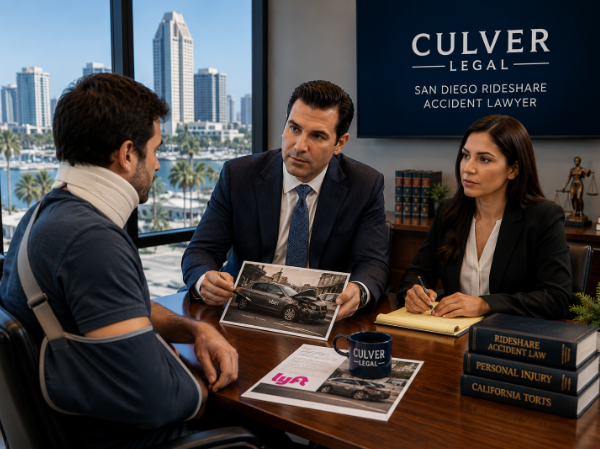
Culver Legal, LLP represents people injured in rideshare collisions across San Diego County. We work on contingency and advance the costs of the case, so there is nothing to pay up front and no fee unless we win. If there is no recovery, you are not charged those costs either. Call (310) 600-7881 at any hour.
The Three Periods, and What Each Is Worth
Public Utilities Code 5433 sets the minimum cover a rideshare company must carry, and it steps up as the driver moves through the job.
The app is off. The driver is simply a private motorist. Only their personal auto policy is in play, and California’s minimum for that is $30,000 for injury to one person. The rideshare company’s cover does not apply at all.
The app is on and the driver is waiting for a request. The statute requires $50,000 for death and personal injury per person, $100,000 per incident, and $30,000 for property damage, for the period “from the moment a participating driver logs on … until the driver accepts a request to transport a passenger”.
A ride has been accepted, or a passenger is in the car. The statute requires $1,000,000 for death, personal injury, and property damage, running “from the moment a participating driver accepts a ride request … until the driver completes the transaction … or until the ride is complete, whichever is later”.
So two identical collisions can produce completely different outcomes, and the fact that decides it lives in the company’s records rather than at the roadside. Establishing it is part of the case rather than a preliminary to it.
If you were the passenger, you are almost always in the best position, because a passenger in the car means a ride was in progress by definition.
Were you a passenger when it happened?
That usually puts a $1,000,000 policy in play rather than a $50,000 one. Worth confirming before you accept anything.
There Is Also Uninsured Motorist Cover You May Not Know About
This is the provision almost nobody mentions and it matters when the other driver caused the crash.
While a passenger is in the vehicle, the same statute requires the rideshare company to carry uninsured and underinsured motorist cover of $60,000 per person and $300,000 per incident.
So where another driver caused the collision and carried little or no insurance, a passenger is not left with nothing. That cover exists specifically for the gap.
And your own policy may respond too. Many auto policies cover the holder for injuries sustained as a passenger in someone else’s vehicle, including uninsured and underinsured motorist cover, and people rarely think to check.
What If the Other Driver Caused It?
Then the ordinary rules apply first: the at-fault driver’s liability policy is the primary source, and the rideshare cover may respond on top where that runs out.
This is where these claims quietly go wrong. California’s minimum liability cover is $30,000 for injury to one person and $60,000 per accident. A single serious injury exhausts a minimum policy, and at that point the question is what else responds: the rideshare uninsured motorist cover above, your own policy, or both.
What You Should Do in the First Days
- Screenshot the trip in the app before anything else. The receipt, the driver’s name, the vehicle, the route and the times. That is the cleanest proof a ride was in progress, and it is the difference between the $50,000 policy and the $1,000,000 one.
- Report it through the app, which creates a record on the company’s side.
- Get medical attention the same day. A head injury can take days to declare itself.
- Photograph the vehicles and the scene.
- Do not accept a quick settlement offered through the app before you know the medical picture.
- Do not give a recorded statement to any insurer before taking advice.
The trip record is the single most useful thing you can preserve, and it is the one thing that disappears if an account is closed or a phone is replaced.
Where You Were Treated, and Where the Case Would Be Heard
San Diego runs a catchment area trauma system, so you were taken to the trauma center for where the crash happened rather than the nearest hospital. The adult Level I centers are Scripps Mercy Hospital San Diego and UC San Diego Medical Center, with Rady Children’s Hospital as the pediatric Level I.
For a collision on a city street inside San Diego the report comes from the San Diego Police Department. It costs $12, reports are not faxed or emailed, and after seven business days you can confirm it is ready on (619) 531-2846. A crash on Interstate 5, 8, 15 or 805 is normally the California Highway Patrol’s instead.
A rideshare claim seeking more than $35,000 is an unlimited civil case, filed at the Hall of Justice, 330 West Broadway, and heard in San Diego County before a San Diego County jury.
Two years is the deadline under Code of Civil Procedure 335.1, and six months if a public entity is involved under Government Code 911.2, which can happen where a city vehicle, an MTS bus or the road itself contributed. A claim against the City of San Diego goes to Risk Management at 1200 Third Ave., Suite 1000, and since 11 December 2023 the city no longer accepts first-notice claims by email.
Has the app already offered you a settlement?
An early offer arrives before your treatment is finished. Get it checked before you accept.
Why Do San Diego Clients Choose Culver Legal?
We establish which period applies before anything else, because it decides whether $50,000 or $1,000,000 is available and every other decision follows from it.
Our team speaks Spanish, Farsi, Filipino, Hindi, Mandarin and Korean.
The economics are simple. Contingency, costs advanced, nothing up front and no fee unless we win. We advance the case costs, and if there is no recovery you are not charged those costs either. Culver Legal has recovered $200 Million and counting, and the phone is answered 24 hours a day.
San Diego Rideshare Accident FAQs
Can I sue Uber or Lyft if I am in an accident?
The more useful question is which policy responds, because that is what determines what your claim can actually recover. California requires a rideshare company to carry $1,000,000 of cover once a driver has accepted a ride or has a passenger aboard, and $50,000 per person while the driver is logged on but still waiting for a request. Where the app was off entirely, only the driver’s personal policy applies. Claims are usually made against those policies rather than against the company in the way people picture, and as a passenger you are almost always in the strongest position because a passenger in the car means a ride was in progress.
I was a passenger in an Uber. Who do I claim against?
It depends who caused the collision, and you are well placed either way. If the rideshare driver was at fault, the $1,000,000 cover applies. If another driver caused it, their liability policy is primary and the rideshare cover may respond on top where that runs out. There is also uninsured and underinsured motorist cover of $60,000 per person while a passenger is in the vehicle, which exists for exactly the case where the at-fault driver had little or no insurance.
Do insurance companies want to settle quickly?
Often yes, and it is worth understanding why rather than assuming bad faith. An early offer is priced on what is known at the time, which is the least that will ever be known about your injury, and accepting it closes the claim including anything that has not declared itself yet. Speed favors the person who knows the most, and in the first weeks that is not you.
The company says the driver was not on a trip. Can that be checked?
Yes, and it matters enormously because it is the difference between a $50,000 policy and a $1,000,000 one. The evidence lives in the company’s own records, and your own app history is the fastest place to start, which is why screenshotting the trip early is worth doing before anything else.
Does my own insurance matter if I was just a passenger?
Often yes, and people rarely check. Many auto policies cover the holder for injuries sustained as a passenger in someone else’s vehicle, including uninsured and underinsured motorist cover. Where the at-fault driver carried a minimum policy that a serious injury exhausts, your own cover can be what closes the gap.
I am undocumented. Can I bring a claim without putting myself at risk?
Yes, and the protection is stronger than most people expect. Under Evidence Code 351.2, added by AB 2159, evidence of a person’s immigration status is not admissible in a civil action for personal injury or wrongful death, and discovery into it is not permitted either. It cannot be raised at trial and it cannot be asked about beforehand. It is not a question we ask you, and it is not a question the other side gets to ask.
Contact a Culver Legal San Diego Rideshare Accident Lawyer
Whether the driver had accepted the ride is worth twenty times more to your claim than anything that happened at the scene, and the proof of it is on a phone. If you were hurt in an Uber or Lyft collision anywhere in San Diego County, reach us at (310) 600-7881 at any hour. The review costs nothing.
Attorney Advertising. Prior results do not guarantee a similar outcome. Culver Legal, LLP is a California law firm. The information on this page is for general informational purposes and does not constitute legal advice.