A construction site is the one workplace where the company that injures you is usually not the company that employs you. There is a general contractor, several trades, a site owner, equipment that belongs to somebody else and was serviced by somebody else again. Everyone answers to a different insurer, and each of them would prefer this to be a workers compensation matter and nothing more.
It is usually not. Labor Code 3852 says a compensation claim “does not affect their claim or right of action for all damages proximately resulting from the injury or death against any person other than the employer.” Compensation covers your employer and stops there. Every other party on that site is an ordinary defendant, and an ordinary defendant pays for pain and suffering, full lost earnings and lost future capacity, none of which compensation pays for.
Culver Legal has recovered $200 Million and counting for injured people in California. We work on contingency, we advance the costs of the case, and there is no fee unless we win. If there is no recovery, you are not charged those costs either. Call (310) 600-7881 at any hour, including tonight.
Does a Cal/OSHA Citation Prove My Case?
No, and the reason is worth understanding because the opposite mistake is just as expensive.
Labor Code 6304.5 is explicit that a citation is inadmissible: “Neither the issuance of, or failure to issue, a citation by the division shall have any application to, nor be considered in, nor be admissible into, evidence in any personal injury or wrongful death action, except as between an employee and his or her own employer.” Investigators from the division also cannot give expert opinion evidence.
But the same sentence keeps the safety orders themselves in play. The section goes on: “Sections 452 and 669 of the Evidence Code shall apply to this division and to occupational safety and health standards adopted under this division in the same manner as any other statute, ordinance, or regulation.”
That matters, because Evidence Code 669 is the negligence per se presumption. Failure to exercise due care “is presumed if” a person violated a statute, ordinance or regulation, the violation proximately caused the injury, the injury was of the kind the enactment was designed to prevent, and the injured person was in the class it was meant to protect.
So the distinction is sharp and it is worth stating plainly. The piece of paper Cal/OSHA issued is out. The safety order they issued it under is in, and proving it was breached can shift the burden rather than merely add an argument. A case built on the citation is built on something a court will exclude. A case built on the standard is built on something the Evidence Code treats like any other regulation.
One exception, in the statute’s own words: the citation bar does not apply “as between an employee and his or her own employer”. That is a narrow carve-out and it does not create a claim against an employer who is otherwise protected by exclusive remedy.
Who Is Actually Liable on a Site?
The general contractor, where it retained control over the conditions that caused the injury. Site-wide safety is usually its responsibility whoever the injured worker is employed by.
Another trade. Whoever created the hazard: an unguarded opening, an unsafe scaffold, a live circuit, a load left where it could fall.
The site or property owner, where the premises themselves were unsafe rather than the work being done on them. That overlaps with an ordinary premises claim.
An equipment manufacturer or a maintenance contractor, where a machine was defective, lacked a guard, or was serviced badly.
A driver, on the many injuries that happen in and around vehicles rather than on the structure: a reversing truck, a delivery, a worker struck in a work zone on Highway 99, Interstate 5 or State Route 58. Those are commercial vehicle claims and they carry their own federal record-retention clock.
A public entity, on public works. That drops the deadline to six months.
Your own employer, but only in the written exceptions. Compensation is the exclusive remedy against them under Labor Code 3602 unless they failed to carry insurance, in which case Labor Code 3706 allows a direct action, or unless the power press exception in Labor Code 4558 applies. Those, and the wider position on claims that run alongside compensation, are set out separately.
Was the citation the only thing anyone looked at?
A Cal/OSHA citation is inadmissible. The safety order behind it is not. Those are two different cases.
What Gets Lost in the First Two Weeks
More than on any other kind of claim, because a site changes by design.
The scene itself. The scaffold gets struck, the opening gets covered, the excavation gets backfilled. Within two weeks the place where it happened may not exist in that form.
The equipment. Repaired, returned to a hire company, or put back into rotation.
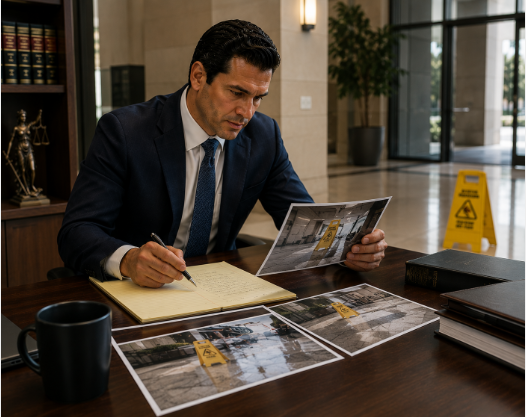
The paperwork that establishes who controlled what. Subcontracts, the site safety plan, toolbox talk records, daily reports, inspection sheets and the sign-in log. All of it exists, none of it is public, and it is what answers the question of which company owed you a duty.
Photographs and phone footage taken by other workers, which are often the only record of the condition before it was made safe.
A written preservation demand, sent early and naming the specific records, is what turns later destruction into something a court can take a view on rather than something that simply happened.
What These Injuries Are Worth
Construction injuries skew severe, and the valuation follows the loss of capacity rather than the bills.
- Falls from height, which produce fractures, spinal injuries and head trauma
- Struck-by and caught-between injuries, including crush injuries to hands and limbs
- Electrocution and burns, valued on a longer horizon because of grafts and revision surgery
- Head injuries, which the emergency record frequently does not capture, and which raise their own questions about a brain injury
Where an injury is fatal, the family’s claim is a wrongful death claim and the rules on who may bring it are stricter than most families expect. Where the death was on a public works project, the six-month government claim deadline applies to that claim too.
How Long Do I Have?
Two years from the date of injury for a third-party claim, under Code of Civil Procedure 335.1.
Six months to present a written claim to a public entity, under Government Code 911.2, on any public works job.
The workers compensation claim runs on its own separate clock, and reporting the injury to your employer has its own much shorter timescale. Meeting one deadline does not protect the other.
Has anyone asked the site to preserve its records?
Subcontracts, daily reports and sign-in logs decide who owed you a duty. The scene itself is gone within two weeks.
If the Site Belonged to a Public Body, the Deadline Changes
Worth checking early, because a great deal of construction work in this county is done on public projects: roads, schools, county and city facilities.
Where a public entity is a defendant, a written claim must be presented within six months under Government Code 911.2, rather than the ordinary two years, and no lawsuit can be filed until that has happened. A claim against the City of Bakersfield goes to the City Clerk at 1600 Truxtun Avenue, 1st floor, and is handled by the city’s Risk Management division on the 5th floor of the same building.
Establish whose project it was rather than assuming. The city, the county, a school district and the state are four separate entities with four separate claims processes, and a claim presented to the wrong one has not been presented at all. Roadway work on Highway 99, Interstate 5 or State Route 58 sits with the state rather than with the city.
Where Will the Case Be Heard, and Where Will I Be Treated?
A construction injury claim seeking more than $35,000 is an unlimited civil case, filed at the Metro Justice Building, 1215 Truxtun Avenue and heard in Kern County before a Kern County jury.
The most serious injuries in the county are taken to Kern Medical, 1700 Mount Vernon Avenue, a Level II trauma center designated in 2001 and re-verified by the American College of Surgeons Committee on Trauma. Where the ambulance took you determines who holds the imaging, the trauma activation record and the first responder narrative.
On a site injury there is a second set of records that matters as much, and it is not medical. The daily report, the toolbox talk sign-in, the equipment inspection log, the subcontractor agreement and the site safety plan together establish who controlled the hazard. They are held by different companies, they are not produced voluntarily, and several of them are routinely overwritten or discarded within weeks. That is the reason to have somebody asking for them early rather than after the medical picture settles.
Why Bakersfield Clients Choose Culver Legal
We come to you. If you are in the hospital, at home and unable to drive, or a long way out in the county, we will meet you where you are.
Our team speaks Spanish, Farsi, Filipino, Hindi, Mandarin and Korean. Explaining what happened on a site in your own words is not a convenience, and on this kind of claim the detail of who told you to do what is often the whole case.
The economics are simple. The firm works on contingency and advances the costs of the case, so there is nothing to pay up front and no fee unless we win. We advance the case costs, and if there is no recovery you are not charged those costs either. Culver Legal has recovered $200 Million and counting, and answers the phone 24 hours a day.
Bakersfield Construction Accident FAQs
Cal/OSHA cited the company. Does that prove my claim?
Not directly. Labor Code 6304.5 makes the citation inadmissible in a personal injury or wrongful death action, except as between an employee and their own employer, and it bars division employees from giving expert opinion. The same section keeps the safety standards themselves admissible on the same footing as any other regulation, so a breach of the standard can support a presumption of negligence under Evidence Code 669. The order matters; the citation does not.
I am already on workers compensation. Why would I bring a lawsuit?
Because compensation does not pay for pain and suffering, pays only a statutory fraction of lost wages, and covers your employer alone. Labor Code 3852 preserves your right of action against anyone else, and on a site that usually means the general contractor, another trade, an owner or an equipment supplier.
Can I sue the general contractor if they did not employ me?
Yes, where their own negligence contributed. A general contractor is a third party as to you no matter who signs your check, and site-wide safety is normally within its control. Whether it retained that control on your particular job is a question the subcontracts and daily reports answer.
The site has been changed and the equipment is gone. Is it too late?
Common, and not the end. Photographs taken by other workers, the paperwork trail and the equipment’s service history all survive the site being made safe. The reason to move early is that a written demand to preserve those records is what stops the next tranche disappearing routinely.
I am undocumented. Can I bring a claim without putting myself at risk?
Yes, and the protection is stronger than most people expect. Under Evidence Code 351.2, added by AB 2159, evidence of a person’s immigration status is not admissible in a civil action for personal injury or wrongful death, and discovery into it is not permitted either. It cannot be raised at trial and it cannot be asked about beforehand.
What kind of lawyer do I need to sue a contractor in California?
For an injury on a site, a personal injury lawyer who handles third-party construction claims, which is a different thing from a construction defect or contract dispute lawyer. The distinction matters because the two run on different law and different deadlines. A defect case is about work that was done badly. Your case is about a person who was hurt, and it turns on who controlled the hazard: the general contractor, another subcontractor, an equipment owner, a property owner, or a public entity. If you were working at the time, it usually runs alongside a workers’ compensation claim rather than instead of one, and the two are handled together.
What is the highest cause of injury for construction workers?
Falls from height are consistently the largest single category in this industry, with being struck by objects or equipment, caught-in and crush injuries, and electrical contact making up most of the rest. The legally useful point is that each of those maps onto a specific safety requirement, which means each one comes with a documented obligation that somebody held. Establishing which safety order applied and who was responsible for meeting it is usually more productive than arguing about what the injured worker was doing at the moment it happened.
Contact a Culver Legal Bakersfield Construction Accident Lawyer
A site stops looking like the place where you were hurt within about two weeks, and the records that say which company owed you a duty are held by the companies themselves. If you were injured on a job anywhere in Bakersfield or Kern County, reach us at (310) 600-7881, at any hour. The review costs nothing and it does not affect your compensation claim.
Attorney Advertising. Prior results do not guarantee a similar outcome. Culver Legal, LLP is a California law firm. The information on this page is for general informational purposes and does not constitute legal advice.