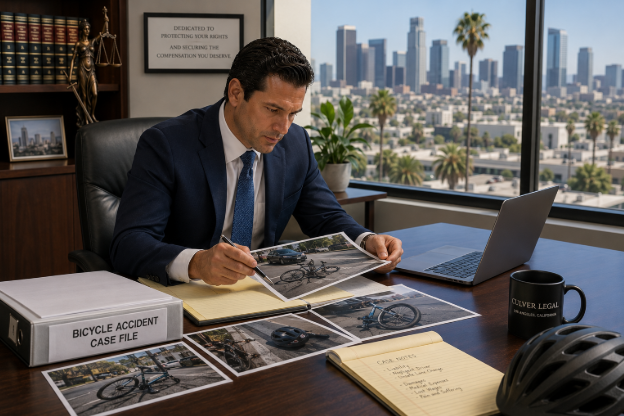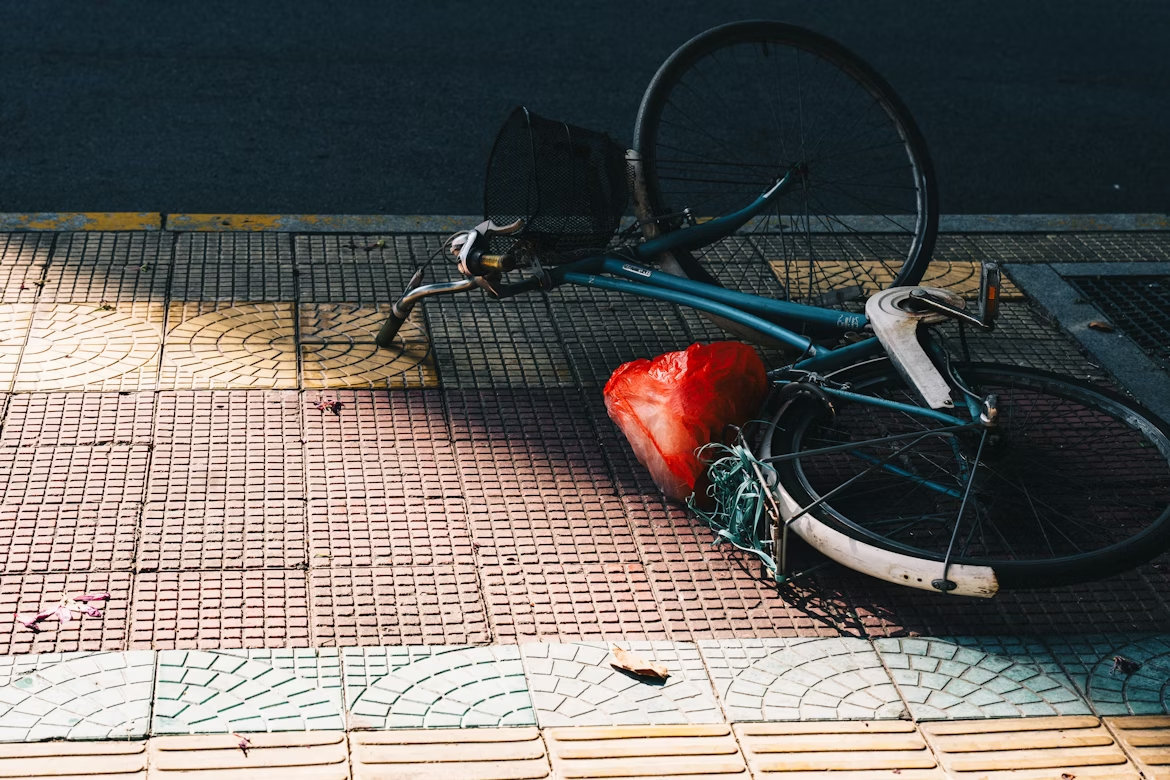
The first thing said about a cyclist hit in Bakersfield is usually that they should not have been there. Too far out in the lane. Should have been on the shoulder. Should have used the bike lane, on a road that has none. It gets said at the scene, and then repeated by an adjuster who was not there.
California law does not require a cyclist to hug the curb, and the section everyone cites is the one that says so. Vehicle Code 21202 asks a rider to keep as close as practicable to the right-hand edge “except under any of the following situations”, and then lists four of them. One is avoiding hazards. Another is a substandard width lane, which the section defines as “a lane that is too narrow for a bicycle and a vehicle to travel safely side by side within the lane.” On a narrow lane the law puts you in it, not beside it.
Culver Legal has recovered $200 Million and counting for injured people in California. We work on contingency, we advance the costs of the case, and there is no fee unless we win. If there is no recovery, you are not charged those costs either. Call (310) 600-7881 at any hour, including tonight.
Did I Have to Ride Closer to the Curb?
Almost certainly not, and the exceptions are where these cases are won.
Vehicle Code 21202 lists four situations in which a cyclist is not required to keep right:
1. Overtaking and passing another bicycle or vehicle going the same way. 2. Preparing for a left turn at an intersection or into a driveway. 3. Avoiding conditions that make it unsafe to continue along the right-hand edge. The section spells these out: “fixed or moving objects, vehicles, bicycles, pedestrians, animals, surface hazards, or substandard width lanes”. 4. Approaching a place where a right turn is authorized, so as not to be cut off by a turning vehicle.
The third exception does most of the work. Parked cars, a broken edge, gravel, a drain grate and a lane too narrow to share all put a rider lawfully further out. An adjuster arguing you were “in the middle of the road” is describing something the statute expressly permits.
How Much Room Does a Driver Have to Give?
Three feet, and the rule has a second half that is less well known.
Vehicle Code 21760 requires a driver overtaking a cyclist to leave at least three feet between any part of the vehicle and any part of the bicycle or its rider.
And if three feet is not available, the answer is not to pass anyway. Subdivision (d) says a driver who cannot comply because of traffic or road conditions “shall slow to a speed that is reasonable and prudent, and may pass only when doing so would not endanger” the cyclist. So a close pass on a narrow road is not excused by the road being narrow. The obligation becomes to wait.
Doors are their own rule. Vehicle Code 22517 is unambiguous: “No person shall open the door of a vehicle on the side available to moving traffic unless it is reasonably safe to do so.” Being doored is not a shared-fault situation by default. The duty sits with the person opening the door.
Were you told you should have been further right?
The statute lists four situations where you are not required to be. A narrow lane is one of them.
What the Bakersfield Data Shows
The California Office of Traffic Safety publishes crash rankings for every city, drawn from statewide collision data, and Bakersfield is measured against the 15 California cities with populations over 250,000. In these tables a rank of 1 is the worst.
| Year | Cyclists killed or injured | Rank of 15 similar cities |
|---|---|---|
| 2020 | 63 | 9 of 15 |
| 2021 | 55 | 14 of 15 |
| 2022 | 68 | 11 of 15 |
| 2023 | 71 | 12 of 15 |
Cyclist injuries have risen in each of the last two published years. Bakersfield’s rank sits in the safer half of its group on this measure, which is worth stating honestly rather than dramatizing, and it does nothing for the 71 people it happened to.
What Causes These Collisions
The same few situations produce most of them, and each one points at a different piece of evidence.
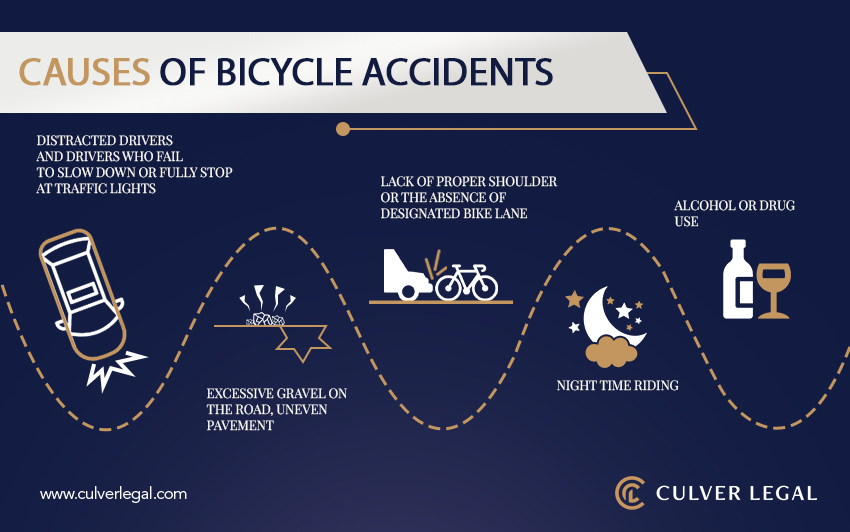
Right hooks and left crosses at intersections, where a driver turns across a rider they had already passed or never looked for. The vehicle’s final position usually settles this.
Doors on street-parked roads, which is why Vehicle Code 22517 exists and why the parked car’s occupant is a defendant rather than a bystander.
Close passes on lanes too narrow to share, the situation Vehicle Code 21202 expressly permits a rider to take the lane in, and the one drivers most often describe as the cyclist’s fault.
Surface defects: a broken edge, a drain grate set the wrong way, gravel in the gutter. Where the road is public, that is a claim against whoever maintains it, on a six-month clock.
Night riding and drivers who had been drinking. In 2023, 340 people were killed or injured in Bakersfield crashes involving alcohol, ranking the city 3rd of 15 comparable cities.
What Should I Do After a Bicycle Accident?
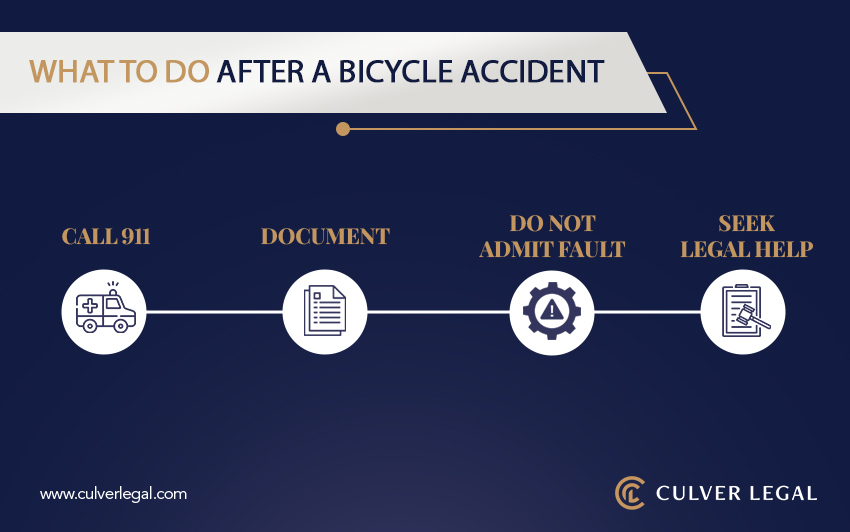
The scene evidence in a bicycle case decides the fault argument, and it is gone within days. The bike gets moved, the debris field gets swept, and the position that would have shown where you were riding stops existing. Photographs taken at the time, from more than one angle, are worth more than any account given later.
If a driver has already said they did not see you, that is worth recording precisely. A driver’s duty includes looking, so not seeing a cyclist describes a failure to keep a proper lookout at least as readily as it excuses one.
What Can I Claim?
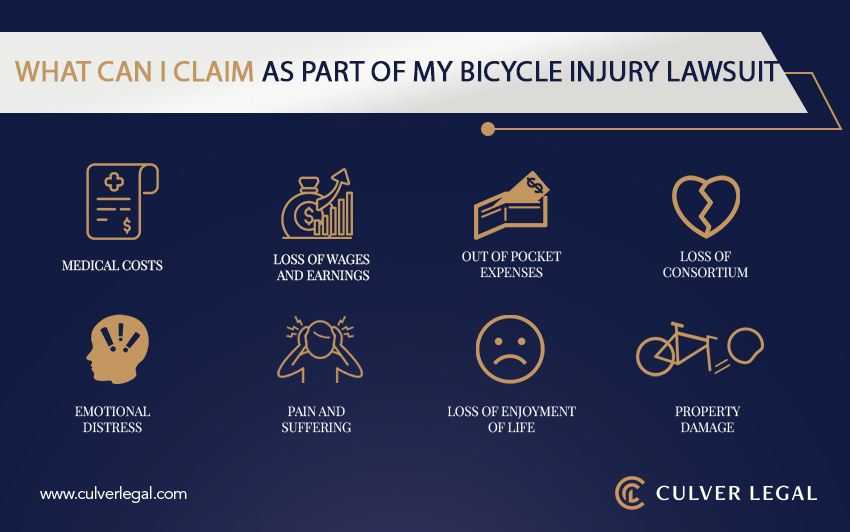
Head injuries are the ones most often missed here, because a rider who got up and gave their details may have a brain injury that declares itself over the following week, and a clear emergency scan is then presented as though it settled the question.
If the vehicle was commercial, the carrier holds records that expire on a federal schedule, and a commercial carrier is on the other side. If a public vehicle or the roadway itself was involved, the deadline shortens to six months, the same way it does for a claim against a public bus operator. Where a collision is fatal, California restricts who may bring a wrongful death claim.
The reasoning about crosswalks and rights of way that governs someone struck while walking also reaches riders, because the 2023 amendments to the pedestrian sections are written in terms of “a moving vehicle or other device moving exclusively by human power”.
How Long Do I Have to File?
Two years from the date of injury, under Code of Civil Procedure 335.1.
Six months to present a written claim to a public entity, under Government Code 911.2. On a bicycle this comes up more than people expect, because a claim about the road surface itself runs against whoever maintains it.
Injured children. Code of Civil Procedure 352 pauses the ordinary limitation period while an injured person is under 18. The six-month government claim rule is not paused in the same way.
Did somebody open a door into you?
Vehicle Code 22517 puts that duty on the person opening it. It is not a shared-fault situation by default.
Who Wrote the Report, and How Do I Get It?
A collision on a city street inside Bakersfield is normally investigated by the Bakersfield Police Department. Reports come from its Records Unit at 1601 Truxtun Avenue, weekdays 8 a.m. to 5 p.m., at a flat $7, on the traffic report line (661) 326-3883. The department says reports usually take five to seven business days, and that injury and fatal collision investigations take several days to weeks. A cyclist struck by a car is in that slower group.
The officers who investigated it work out of the Traffic Section at 1301 Buena Vista Road, which is across the city from the counter where the report is sold. A collision out on Highway 99, Interstate 5 or State Route 58 is normally a Highway Patrol matter instead.
A cyclist is more likely than a driver to have no report at all. Where a driver clipped you and left, or where nobody called it in because you got up and walked the bike home, the file may never have been opened. That is worth fixing rather than accepting: the medical record made when the injuries declared themselves, photographs of the bike and of the road, and any business or doorbell camera along the route all still exist for a while. Camera footage is the part with the shortest life, usually days.
Where Would the Case Be Heard, and Where Will I Be Treated?
A bicycle injury claim seeking more than $35,000 is an unlimited civil case, filed at the Metro Justice Building, 1215 Truxtun Avenue and heard in Kern County before a Kern County jury.
The most serious injuries in the county go to Kern Medical, 1700 Mount Vernon Avenue, a Level II trauma center designated in 2001 and re-verified by the American College of Surgeons Committee on Trauma. Where the ambulance took you decides who holds the imaging and the trauma activation record. If you were not taken by ambulance at all, which is common for cyclists who feel able to stand up afterwards, the first medical record you do create becomes the anchor for everything later, and a delay in making one is the first thing an adjuster will point at.
Why Bakersfield Clients Choose Culver Legal
We come to you. If you are in the hospital, at home and unable to drive, or a long way out in the county, we will meet you where you are.
Our team speaks Spanish, Farsi, Filipino, Hindi, Mandarin and Korean. Explaining your own accident in your own words is not a convenience.
The economics are simple. The firm works on contingency and advances the costs of the case, so there is nothing to pay up front and no fee unless we win. We advance the case costs, and if there is no recovery you are not charged those costs either. Culver Legal has recovered $200 Million and counting, and answers the phone 24 hours a day.
Bakersfield Bicycle Accident FAQs
The driver says I was too far out in the lane. Does that make it my fault?
Usually not. Vehicle Code 21202 asks a cyclist to keep as close as practicable to the right-hand edge “except under any of the following situations”, and lists four. One covers avoiding hazards such as parked cars, surface defects and substandard width lanes, which the section defines as any lane too narrow for a bicycle and a vehicle to travel safely side by side. On most Bakersfield streets without a bike lane, that description fits.
How close is a driver allowed to pass me?
No closer than three feet, under Vehicle Code 21760. If road or traffic conditions make three feet impossible, subdivision (d) requires the driver to slow to a reasonable and prudent speed and pass only when it would not endanger you. A narrow road is not a defense to a close pass.
Someone opened a car door into me. Whose fault is that?
Vehicle Code 22517 says nobody may open a door on the traffic side unless it is reasonably safe to do so. The duty sits with the person opening it, so being doored is not a shared-fault situation by default.
I was not wearing a helmet. Does that end my claim?
No. In California a helmet is required for riders under 18. For an adult, not wearing one is something the other side may raise, and its effect is confined to injuries a helmet would have prevented rather than applied to the whole claim. California reduces recovery in proportion to fault rather than barring it.
I am undocumented. Can I bring a claim without putting myself at risk?
Yes, and the protection is stronger than most people expect. Under Evidence Code 351.2, added by AB 2159, evidence of a person’s immigration status is not admissible in a civil action for personal injury or wrongful death, and discovery into it is not permitted either.
What are the bike laws in Bakersfield?
The rules that decide a claim are state law rather than city law, and they apply the same way here as anywhere in California. A bicycle on the road is a vehicle for most purposes. Riding slower than traffic means keeping right, but Vehicle Code 21202 carries a list of exceptions wide enough that most real riding falls inside one of them: passing, turning left, avoiding a hazard, or a lane too narrow to share safely. Drivers passing you must give three feet under Vehicle Code 21760, which makes a close pass a violation rather than a matter of opinion. A city can add its own rules on top, on things like riding on sidewalks, and those vary by jurisdiction. If a local rule is being used against you, it is worth checking that it actually says what the other side claims it says.
Who is at fault if a car hits a bicycle?
It is decided on the facts, not by the vehicle types, and the two statutes above do most of the work. The assumption that the cyclist must have been somewhere they should not have been is the thing to test first, because the exceptions in 21202 are broad and the three-foot rule in 21760 puts the obligation on the driver doing the passing. Even where a rider did something wrong, California reduces a recovery in proportion to fault rather than barring it.
Contact a Culver Legal Bakersfield Bicycle Accident Lawyer
The version that reaches the insurer first is usually the driver’s, and the physical evidence that answers it disappears within days. If you were hurt riding anywhere in Bakersfield or Kern County, reach us at (310) 600-7881, at any hour. The review costs nothing.
Attorney Advertising. Prior results do not guarantee a similar outcome. Culver Legal, LLP is a California law firm. The information on this page is for general informational purposes and does not constitute legal advice.