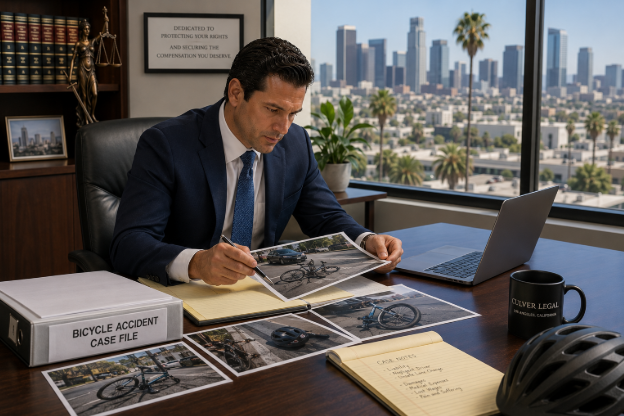
If you have been knocked off a bike in this city, somebody has already explained to you why it was your own fault. No helmet. Too far out in the lane. Came out of nowhere. Rode into an opening door. It arrives from the driver, sometimes from a witness, and eventually in writing from an insurer.
Almost none of it is what the Vehicle Code says. Take the last one, because it is the most common serious bicycle crash in Los Angeles. Under Vehicle Code 22517, “no person shall open the door of a vehicle on the side available to moving traffic unless it is reasonably safe to do so”. The duty is on the person opening the door. Not on you for being beside it.
Culver Legal has recovered $200 Million and counting for injured people in California. Contingency, costs advanced, no fee unless we win, and no costs to repay if there is no recovery. Call (310) 600-7881 at any hour.
The Four Things You Will Be Blamed For, and What the Law Says
“You weren’t wearing a helmet.” Vehicle Code 21212 requires a helmet for a person under 18 years of age. An adult cyclist riding without one has broken no law at all. An insurer may still argue it affected the injury, and California reduces recovery by fault rather than barring it, so that is an argument about a percentage rather than about whether you have a claim.
“You should have been further right.” Vehicle Code 21202 does say ride as close as practicable to the right when moving slower than traffic, and then lists the exceptions: overtaking, preparing to turn left, and when reasonably necessary to avoid conditions “including, but not limited to, fixed or moving objects, vehicles, bicycles, pedestrians, animals, surface hazards, or substandard width lanes“. Most Los Angeles lanes beside parked cars are exactly that.
“You came out of nowhere.” Vehicle Code 21760, the Three Feet for Safety Act, requires a driver overtaking a bicycle to pass at a safe distance having regard to size, speed, traffic, weather, visibility and the width of the road. A driver who passed close enough to hit you was not keeping a safe distance, whatever they saw or did not see.
“You rode into the door.” Vehicle Code 22517, above.
Where Do Most Los Angeles Bicycle Crashes Happen?
The door zone, on every street with parallel parking and a painted bike lane running beside it. This is the design problem behind the single most common serious crash here.
Right hooks, where a driver overtakes and then turns across the cyclist they have just passed.
Left crosses, where an oncoming driver turns across a cyclist they judged as slower than they were.
Bike lanes that end, dumping a rider into moving traffic mid-block, which is also where the substandard width lane exception in 21202 usually starts mattering.
The corridors these happen on are the same ones that dominate every other crash type in this city. Venice, Figueroa, Vermont, Western and Sepulveda are wide, fast, carry parked cars beside moving traffic, and run long distances between signals. That combination is what produces the door zone and the right hook, and it is why a rider taking the lane on one of them is usually making the safer choice rather than the aggressive one.
What Injuries Do Bicycle Crashes Cause?
Head injuries, helmet or not. A helmet reduces skull fracture far more reliably than it reduces the brain moving inside it, so if somebody has not been themselves since a crash that is a brain injury question.
Clavicle and shoulder fractures, the signature cycling injury, from going over the bars.
Wrist and forearm fractures from bracing.
Road rash, which is a burn injury by another name, needs debridement, scars permanently, and is undervalued because the word sounds trivial. It is valued on the same long horizon, because grafts and revision surgery may be years away.
Fatal injuries, where the claim becomes a wrongful death claim and California limits who may bring one.
Who hit you changes the case more than what it did to you. A private driver is an ordinary car accident claim. A commercial vehicle brings federal records that expire on a schedule, which is what a commercial vehicle claim turns on. A public bus or a city vehicle drops the deadline to six months, the same rule that governs a claim against a transit operator. And a rider working at the time, delivering or couriering, has a work injury claim running alongside whichever of those applies.
Were you doored?
The Vehicle Code puts the duty on the person opening the door, not on the rider beside it.

What Is My Los Angeles Bicycle Accident Claim Worth?
- Medical costs already incurred, from the scene through surgery, debridement and therapy
- Future care, including hardware removal and scar revision still ahead
- Lost income, and lost earning capacity where a shoulder or a wrist ends a kind of work
- Pain and suffering, valued against the medical record
- Permanent scarring, valued separately
- The bicycle, the helmet and the kit. All of it is property, and a bike that is written off in a city where it was your transport is a real loss rather than a footnote
Which Court Will Hear My Los Angeles Case?
The court covering the place where you were hit, not the one nearest your home.
Los Angeles County handles this differently from most of California, and it is set out in a standing order of the court. General Order 2024-GEN-003-00, filed 17 May 2024, records that since 10 October 2022 every newly filed personal injury case is filed in the judicial district where the incident arose.
The court is also retiring its Personal Injury Hub in favor of Independent Calendar courtrooms, where one judge manages the case throughout. Since 8 January 2024 personal injury cases in the Central District have been assigned to IC departments at the Stanley Mosk Courthouse. Hub departments have been closing into new IC courtrooms as that proceeds, Department 30 into Department T at the Alhambra Courthouse and Department 31 into Department B at the Van Nuys Courthouse.
That does not change whether you have a claim. It changes where it is filed and who manages it, and filing in the wrong district spends time a two-year deadline does not give back.
Where You Are Taken Matters, and in Los Angeles It Varies
Los Angeles County has fifteen designated trauma centers, and which one receives you depends on where the collision happened rather than on where you live.
Verified against the California EMS Authority’s designated and ACS-verified trauma center list, the Level I centers in and around the city are Cedars-Sinai Medical Center, Los Angeles General Medical Center, Ronald Reagan UCLA Medical Center, Harbor-UCLA Medical Center, and Children’s Hospital Los Angeles for children. Level II centers including California Hospital Medical Center, Northridge, Providence Holy Cross, St. Francis and Huntington Memorial cover the rest of the county.
Why that belongs in a legal claim rather than a medical one. The records that prove your injury sit with whichever facility received you, and across a county this size that is frequently not the hospital nearest your home. A serious injury also generates records at more than one facility as somebody is transferred. Gathering all of them, rather than the first set to arrive, is a large part of what an early demand gets wrong.
How Long Do I Have to File a Bicycle Claim in Los Angeles?
Two years from the crash under Code of Civil Procedure 335.1.
Six months where a public entity is involved, under Government Code 911.2. On a bicycle this catches road surface itself: an unrepaired pothole, a sunken utility cover, a metal plate, or gravel left after resurfacing, none of which would trouble a car.
Up to a year by application if that was missed, under Government Code 911.4 and Government Code 911.6.
Two further grounds matter here and are easy to miss, because they are the ones most people actually fall under. Government Code 911.6(b) also requires the application to be granted where the injured person was a minor for any part of the six months, or was physically or mentally incapacitated for any part of it, provided the application is made within six months of them turning eighteen or of the incapacity ending, or a year after the claim accrued, whichever comes first.
Injured children. Code of Civil Procedure 352 pauses the ordinary period while an injured person is under 18, which matters here because so many cyclists are.
Did the road surface put you down?
A pothole or a metal plate makes it a claim against a public entity, on six months rather than two years.
What Should I Do After a Bicycle Crash in Los Angeles?
Say it if you are hurting. LAPD’s own training material states that no report is required where a collision produced vehicle damage only with no injury and no complained-of pain. Any complained-of pain or visible injury requires one.
Photograph the lane, not just the bike. Where the bike lane runs, how wide it is, how close the parking is, whether the lane ends. On a cycling case the geometry of the street is the argument.
Keep the bike and the helmet exactly as they are. Do not repair, replace or throw anything away. A cracked helmet and a bent fork describe forces that no witness can.
Get the details of anyone who stopped, and look for cameras on the buildings you passed.
Get examined the same day, even if you rode home.
What does it cost, and what comes out of a settlement? Nothing up front. There is no fee unless we win. Out of a settlement come the fee, the case costs advanced, and any medical liens, which is why the headline figure and the amount you receive are different numbers. The full breakdown is in how a California bicycle claim works.
Why Do Los Angeles Cyclists Choose Culver Legal?
We come to you. In the hospital, at home, or anywhere that does not require the bike you no longer have.
Our team speaks Spanish, Farsi, Filipino, Hindi, Mandarin and Korean.
Nothing up front. Contingency, costs advanced by the firm, no fee unless we win. We advance the case costs, and if there is no recovery you are not charged those costs either. Culver Legal was founded in 2020, has recovered $200 Million and counting, and answers the phone 24 hours a day.
Los Angeles Bicycle Accident FAQs
I am undocumented. Can I still bring a claim without putting myself at risk?
Yes, and the protection is stronger than most people expect. Under Evidence Code 351.2, added by AB 2159, evidence of a person’s immigration status is not admissible in a civil action for personal injury or wrongful death, and discovery into it is not permitted either. So it cannot be raised at trial and it cannot be asked about beforehand. It is not a question we ask you, and it is not a question the other side gets to ask.
I was not wearing a helmet. Does that finish my claim?
No. Vehicle Code 21212 requires a helmet for riders under 18. If you are an adult, you broke no law by riding without one. An insurer may argue it made an injury worse, and California reduces recovery in proportion to fault rather than barring it, so that is an argument about percentage. It is also an argument that has to be tied to the injury you actually suffered.
A parked driver opened a door into me. Whose fault is that?
Theirs, on the face of the statute. Vehicle Code 22517 says no person shall open a door on the side available to moving traffic unless it is reasonably safe to do so. The duty sits with the person opening it. This is the most common serious bicycle crash in Los Angeles and the one most often misdescribed to the rider as their own error.
The driver says I was riding too far out in the lane. Is that a rule I broke?
Usually not. Vehicle Code 21202 asks a slower cyclist to keep as close as practicable to the right, and then lists exceptions that cover most of why anyone moves out: overtaking, preparing to turn left, and avoiding surface hazards or substandard width lanes. A narrow lane beside parked cars is the textbook example.
Contact a Culver Legal Los Angeles Bicycle Accident Lawyer
If you were knocked off a bike anywhere in Los Angeles, call (310) 600-7881 at any hour. The review costs nothing, and it is worth making before you accept anybody’s account of whose fault it was.
Attorney Advertising. Prior results do not guarantee a similar outcome. Culver Legal, LLP is a California law firm. The information on this page is for general informational purposes and does not constitute legal advice.