 Skip to Content
Serving All of California - Hablamos Espanol
Serving All of California 24/7
Work Injury Lawyer in Long Beach
A workplace injury can put you out of work, pile up medical bills, and leave you unsure of what you are owed. Workers’ compensation covers some of it. But in Long Beach, where industries range from the sprawling ports of the harbor district to construction sites along Pacific Coast Highway, the full picture of what you can recover is often bigger than the workers’ comp system lets on. A personal injury attorney who handles work injury cases can tell you whether a third party is liable and what that claim could be worth.
At busy industrial sites, warehouses near the Long Beach port complex, and commercial corridors throughout the city, workplace accidents happen fast. Forklifts, scaffolding failures, defective equipment, toxic exposures, and vehicle collisions on the job all carry serious injury risk. The injuries are real. So are the gaps in what workers’ comp alone will pay.
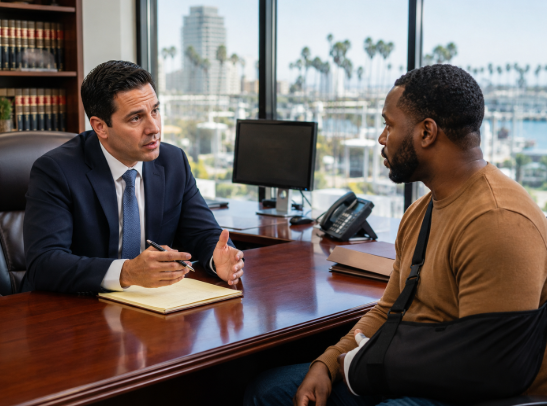
Workers’ Comp Is Not the Only Option
California workers’ compensation provides medical care and partial wage replacement after a workplace injury. It is no-fault, which means you do not have to prove your employer was negligent to collect. But workers’ comp also caps what you can recover. It does not pay for pain and suffering. It does not restore your full lost wages. And it does not compensate you for long-term disability beyond certain formulas that rarely match real-world loss.
When a party other than your employer contributed to your injury, you may have a separate civil lawsuit available alongside your workers’ comp claim. That third-party claim can recover full damages, including pain and suffering, complete lost earnings, and future medical expenses. You can pursue both simultaneously under California law.
Common third-party defendants in Long Beach work injury cases include:
- Equipment manufacturers whose defective machinery caused the injury
- Property owners where the work was performed, if they were not your employer
- Contractors or subcontractors on a shared job site
- Drivers who caused a vehicle accident while you were working
- Chemical or product suppliers responsible for a toxic exposure
California Law and Your Right to File
Under California Code of Civil Procedure Section 335.1, you have two years from the date of injury to file a personal injury lawsuit against a third party. Workers’ compensation claims carry their own shorter deadlines. If a government entity is involved, you have six months to file an administrative claim before pursuing a lawsuit. Missing either deadline can bar your recovery entirely.
California is a pure comparative fault state. If you are found partially responsible for your injury, your compensation is reduced by your fault percentage. It is not eliminated. If your case is worth $500,000 and you are found 20% at fault, you still recover $400,000. Do not assume partial fault means you have no case.
If your immigration status has kept you from filing, know this: California law prohibits using immigration status as a basis to deny a workers’ compensation or personal injury claim. Your right to seek compensation does not depend on your documentation status.
Work injury cases in Long Beach involving dock workers, longshoremen, or maritime employees may also fall under federal maritime law or the Longshore and Harbor Workers’ Compensation Act, which carries different rules than the state system. The port area generates some of the most complex workplace injury claims in the state. If your injury occurred near the harbor or aboard a vessel, the legal framework changes significantly, and you need an attorney familiar with both systems. For an overview of how California personal injury law applies across different incident types, the California personal injury resource explains the broader framework.
What to Do After a Work Injury in Long Beach
- Report the injury to your employer immediately and in writing. Delays in reporting can be used to challenge your claim.
- Seek medical care right away. If your employer directs you to a specific provider under their workers’ comp network, you may be required to start there. Document everything.
- Do not give a recorded statement to any insurance adjuster before speaking with an attorney.
- Preserve evidence. Photograph the scene, the equipment involved, and your injuries. Get witness names and contact information.
- Save all paperwork: incident reports, medical records, pay stubs showing lost wages, and any communications with your employer or their insurer.
- Contact a work injury attorney before accepting any settlement. Insurers often move quickly to close claims for less than they are worth.
Expert Legal Tip from the Attorneys at Culver Legal: One of the most common mistakes we see is injured workers accepting the first settlement offer from a workers’ comp insurer before the full extent of their injuries is known. Spinal injuries, traumatic brain injuries, and occupational disease can take weeks or months to fully manifest. Once you sign a release, you cannot go back for more. Do not settle until you have reached maximum medical improvement and a doctor has documented your permanent restrictions. Call us first.
What Workplace Injuries Can Cost You
Work injuries range from soft tissue strains to catastrophic events. In Long Beach workplaces, the most serious claims often involve:
- Back and spinal injuries from falls or heavy lifting
- Crush injuries from industrial equipment and machinery
- Head and brain injuries from falls, falling objects, or vehicle collisions on-site
- Burns from chemical exposure or electrical incidents
- Repetitive stress injuries that develop over time in warehousing, shipping, and construction roles
- Occupational illness from toxic substance exposure at industrial sites near the port
The financial toll goes beyond medical bills. Lost wages during recovery, reduced future earning capacity, and the cost of long-term care or rehabilitation add up fast. A workers’ comp settlement that looks reasonable on paper can leave you far short of covering those losses over a lifetime.

Why Culver Legal Handles These Cases
Culver Legal has recovered over $1 billion for injured clients across California. That track record includes a $3 million truck accident recovery, a $2.5 million commercial accident settlement, and a $4 million auto accident result. Work injury cases that involve third-party defendants require the same aggressive investigation and litigation approach as any major personal injury claim.
The firm’s attorneys handle cases across Long Beach and the surrounding region, including Compton, Carson, Torrance, Lakewood, and Signal Hill. They work on contingency, meaning no fees unless they win. Free case evaluations are available 24 hours a day. The firm is bilingual in English and Spanish.
Attorneys at Culver Legal include Thanos Simoudis, David Merabi, Dario C. Gomez, Victoria Manesh, Michael Domingo, and Michael B. Huynh.
Frequently Asked Questions
Can I file a lawsuit if I already filed a workers’ comp claim?
Yes. Workers’ compensation and a third-party personal injury lawsuit are separate legal tracks. Filing one does not prevent you from pursuing the other. If a party outside your employer contributed to your injury, you can bring a civil lawsuit for full damages while your workers’ comp claim is pending. California law allows both to proceed at the same time.
Does filing a work injury claim affect my job?
California law prohibits employers from retaliating against employees for filing a workers’ compensation claim. If you face demotion, reduced hours, or termination after reporting a workplace injury, that may be a separate legal violation with its own remedies. Document any change in your work status after you report your injury.
What if I were hurt at the Long Beach port or on a vessel?
Maritime workers, longshoremen, and seamen may be covered under federal maritime law or the Longshore and Harbor Workers’ Compensation Act rather than California’s state workers’ comp system. These federal frameworks have different benefits, procedures, and deadlines. An attorney familiar with both state and federal systems is essential for port-area injury claims.
How long do I have to file a work injury claim in Long Beach?
For a workers’ compensation claim, you must report the injury to your employer within 30 days and file a claim form promptly. For a third-party personal injury lawsuit under California Code of Civil Procedure Section 335.1, you have two years from the date of injury. If a government entity is involved, a six-month administrative claim deadline applies. Missing these deadlines can eliminate your right to recover.
What if I were partially at fault for my own injury?
California’s pure comparative fault rule still allows you to recover. If your injury is valued at $300,000 and you are found 30% at fault, you recover $210,000. Fault percentage reduces your recovery but does not bar it. Workers’ comp claims are no-fault entirely, so fault is not a factor in that track at all.
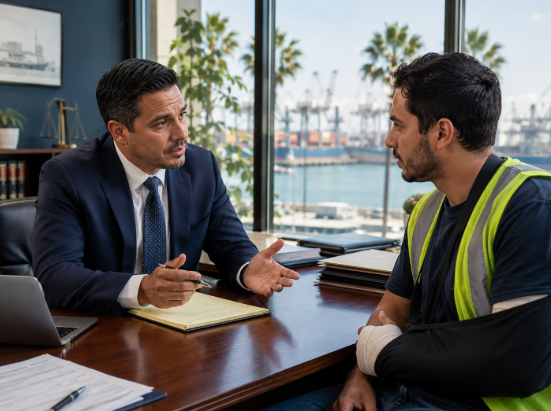
Talk to a Long Beach Work Injury Lawyer Now
If you were hurt on the job in Long Beach and you are not sure whether you have more than a workers’ comp claim, that question deserves a direct answer before any deadline passes. Culver Legal offers free case evaluations around the clock. There are no fees unless we win your case.
This content has been reviewed by the attorneys at Culver Legal, LLP, licensed to practice law in the State of California.
Culver Legal, LLP
5670 Wilshire Blvd., Suite 1370
Los Angeles, CA 90036
(310) 600-7881
Serving Long Beach and nearby communities, including Compton, Carson, Torrance, Lakewood, and Signal Hill.
Attorney Advertising. Past results do not guarantee future outcomes.
Learn more about your options for compensation by calling 310-600-7881 .
Trusted by Thousands. Millions Recovered For Our Clients
YOU Deserve the Best
Free Case Review 24/7 You Don’t Pay unless we win
CALL 310-600-7881
"*" indicates required fields
Featured Lawyers
-

David Merabi
-

Thanos Simoudis
-

Victoria Manesh
-

Michael B. Huynh
-

Michael Domingo
-

Darío C. Gómez
