Workers’ compensation pays nothing for pain and suffering. If somebody other than your employer caused your injury, there is a second claim that does, and it is separate from your compensation case.
That is the part most injured workers are never told. Workers’ compensation is a no-fault system: it covers medical treatment and a portion of lost wages regardless of who was at fault, and in exchange it generally bars suing your employer. It does not bar suing anybody else.
Culver Legal, LLP brings civil claims for injured workers across Huntington Park on contingency, with case costs advanced. Nothing to pay up front, no fee unless we win. We advance the case costs, and if there is no recovery you are not charged those costs either. We speak Spanish. Call (310) 600-7881 at any hour.
When Somebody Other Than Your Employer Is Responsible
These are the situations where a civil claim exists alongside a compensation claim, and they are more common than people expect.
You were driving for work and another driver hit you. The at-fault driver is a third party, and this is the example most easily missed, because the compensation claim gets opened for you and the civil one does not.
Another company’s employee caused it. On shared sites, in warehouses, at delivery points and on construction sites, the person who created the hazard often works for a different company entirely.
A machine, tool or component failed. The manufacturer, distributor or maintenance contractor may be responsible, and that is a claim your employer’s insurer has no reason to pursue for you.
You were injured on premises somebody else controls. A property owner or occupier owes duties to people lawfully there, including workers.
A defective or unsafe vehicle, where the fault lies with whoever built, sold or serviced it.
In each of those, the civil claim covers what workers’ compensation does not, including pain and suffering, the full extent of lost earnings and future earning capacity.
What Each Claim Actually Pays
The two remedies do not overlap as much as people assume, and the gap is the reason the second one matters.
| Workers’ compensation | Third-party civil claim | |
|---|---|---|
| Do you have to prove fault? | No. It is a no-fault system | Yes. Negligence has to be established |
| Medical treatment | Covered | Covered |
| Lost wages | A portion of them | The full loss, including future earning capacity |
| Pain and suffering | Nothing | Recoverable |
| Who it is against | Your employer’s insurer | Whoever else was responsible |
The pain and suffering row is the one that surprises people, and on a serious injury it is often the largest part of what a civil claim is worth. Somebody who accepts that compensation benefits are all that exists has not settled their claim. They have simply never made it.
Hurt at work by someone who is not your employer?
That is a separate civil claim, and it covers what workers’ compensation does not.
If Your Employer Had No Workers’ Compensation Coverage
There is a specific provision for this and it is short.
Labor Code 3706 provides that if any employer fails to secure the payment of compensation, any injured employee or their dependents may bring an action at law against that employer for damages, as if this division did not apply.
The last phrase is the important one. Where the employer has not secured cover, the ordinary bar on suing them falls away and the claim proceeds as a civil action. If you were told there is no insurance, or you suspect there is none, that is worth establishing rather than accepting.
How Long Do You Have?
Two years from the date of injury for a civil claim against a third party, under Code of Civil Procedure 335.1.
Six months to present a written claim where a public entity is a responsible party, under Government Code 911.2. Separately, Government Code 945.4 bars a lawsuit for money damages until that claim has been presented and the entity has either acted on it or is treated as having rejected it. A claim the entity simply ignores is deemed rejected once the 45 days are up, which is what allows the lawsuit to proceed.
And presenting the claim is not the last deadline. Once the entity mails or delivers a written rejection, Government Code 945.6 gives you six months from the date of that notice to file suit. If the entity never sends a written rejection, the period is two years from when the cause of action accrued instead. A claim that is ignored therefore leaves more time than one that is formally rejected, which is the opposite of what most people expect.
Which entity decides where the claim goes. Where it is the City of Huntington Park, it is filed with the City Clerk at 6550 Miles Avenue, and the city’s own Ordinance 624-NS requires it to act within 45 days. A school district, a state agency or a neighboring city each has its own process and its own address, and sending a claim to the wrong counter is not the same as filing it.
If the six months has already passed, Government Code 911.4 allows a written application for permission to present a late claim, within a reasonable time and no more than a year after it arose, and Government Code 911.6 says the board shall grant it on any of several grounds, including that the injured person was a minor, was physically or mentally incapacitated, or died before the six months expired.
Two further grounds matter here and are easy to miss, because they are the ones most people actually fall under. Government Code 911.6(b) also requires the application to be granted where the injured person was a minor for any part of the six months, or was physically or mentally incapacitated for any part of it, provided the application is made within six months of them turning eighteen or of the incapacity ending, or a year after the claim accrued, whichever comes first.
Workers’ compensation is a separate system with its own deadlines and its own process, and those are not the deadlines above. Report a workplace injury to your employer promptly. Where a compensation matter needs handling as well, we will tell you plainly rather than leave you to find out.
What to Do
Report the injury to your employer in writing and keep a copy. A dated report anchors everything that follows, in either system.
Write down which companies were on site and who was doing what. In a third-party claim the identity of the other company is the case, and crews move on.
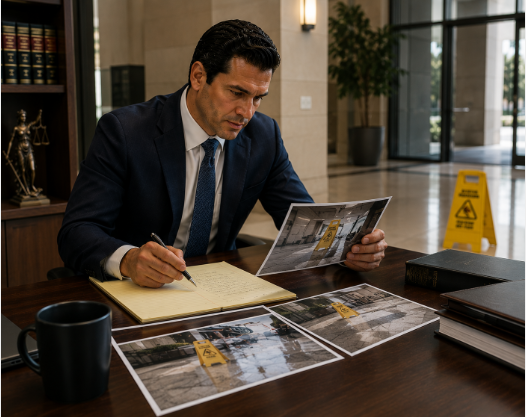
Photograph the scene and the equipment before it changes.
Get medical attention and be precise about how it happened. The mechanism recorded in the first medical note gets quoted back for the life of the claim.
Do not give a recorded statement to another company’s insurer without advice.
Where Would the Case Be Heard?
Not at the courthouse in Huntington Park. Per the Los Angeles Superior Court’s own filing court locator for this city, an unlimited civil case, meaning a claim seeking more than $35,000, goes to the Norwalk Courthouse, 12720 Norwalk Blvd, Norwalk, CA 90650, and a limited civil case goes to the Stanley Mosk Courthouse downtown. Since October 2022 the court has assigned newly filed personal injury cases to the judicial district where the incident arose.
Not sure whether you have a second claim?
The review costs nothing and commits you to nothing. One conversation establishes who else was involved.
Huntington Park Work Injury FAQs
I am already receiving workers’ compensation. Can I still bring a claim?
Often yes. Workers’ compensation is no-fault cover from your employer’s insurer and it pays nothing for pain and suffering. A civil claim against a third party who caused the injury, another company’s worker, a driver, a manufacturer, a property owner, covers what compensation does not. Receiving benefits does not remove that right, and pursuing one does not mean giving up the other.
Can you sue your workplace for an injury?
Usually not your employer directly, because workers’ compensation is the exchange: it pays regardless of fault, and in return it generally bars suing the employer. There are two important exceptions. Where somebody other than your employer caused the injury, you can sue them, and that claim covers what compensation does not. And where your employer failed to secure workers’ compensation at all, Labor Code 3706 lets you sue the employer at law as if the compensation system did not apply.
Who counts as a third party?
Anyone other than your employer whose negligence contributed. The most common is another driver where you were injured driving for work. Others are another company’s employee on a shared site, the manufacturer of equipment that failed, a maintenance contractor, or the owner of premises you were working on. If more than one company was involved in what happened, that question is worth asking.
What if my employer has no workers’ compensation insurance?
Then the ordinary bar on suing your employer does not apply. Labor Code 3706 provides that where an employer has failed to secure the payment of compensation, an injured employee or their dependents may bring an action at law against that employer for damages as if the workers’ compensation system did not apply. Whether cover exists is a fact worth establishing rather than assuming either way.
How long do I have to sue for a work-related injury?
Two years from the date of injury for a civil claim against a third party. Six months where a public entity is a responsible party, and that deadline is for presenting a written claim to the entity concerned. Workers’ compensation is a separate system with separate deadlines, so the answer depends on which claim is being asked about, and often both exist at once.
Can I be fired for making a claim?
If that is a concern, say so at the outset rather than after something has happened, because how it is handled differs depending on which claim it touches. Where something has already happened at work in response, that is an employment question rather than part of the injury claim, and it is worth raising when you call so it can be pointed in the right direction.
Does my immigration status affect my claim?
No. Under Evidence Code 351.2, evidence of a person’s immigration status is not admissible in a civil action for personal injury or wrongful death, and discovery into it is not permitted either. It cannot be raised at trial and it cannot be asked about beforehand.
Contact a Culver Legal Huntington Park Work Injury Lawyer
If somebody other than your employer caused your injury, there is a claim workers’ compensation does not cover. If a public entity was involved, the deadline is six months. Call (310) 600-7881 at any hour. The review costs nothing.
Attorney Advertising. Prior results do not guarantee a similar outcome. Culver Legal, LLP is a California law firm. The information on this page is for general informational purposes and does not constitute legal advice.