 Skip to Content
Serving All of California - Hablamos Espanol
Serving All of California 24/7
Rideshare Accident Lawyer in Long Beach
You opened the app, got in the car, and expected to reach your destination safely. Instead, you are dealing with injuries, medical bills, and an insurance company that is already looking for reasons to pay you as little as possible. Rideshare accident claims in Long Beach are legally complex in ways that standard car accident claims are not. Three separate insurance policies may apply to your case. Which one covers you depends on exactly what the driver was doing at the moment of the crash. Getting that answer wrong costs victims real money.
California’s rideshare insurance rules are spelled out under California Public Utilities Code Section 5432, which divides coverage into three tiers based on the driver’s app status at the time of the collision. If the app is off, only the driver’s personal policy applies. If the app is on but no ride has been accepted, limited rideshare coverage kicks in. If a ride is active, the full $1 million rideshare liability policy is in force. Insurance companies dispute app status aggressively because the difference between tiers can mean hundreds of thousands of dollars. Without an attorney reviewing the TNC records immediately, that dispute rarely goes in the victim’s favor.
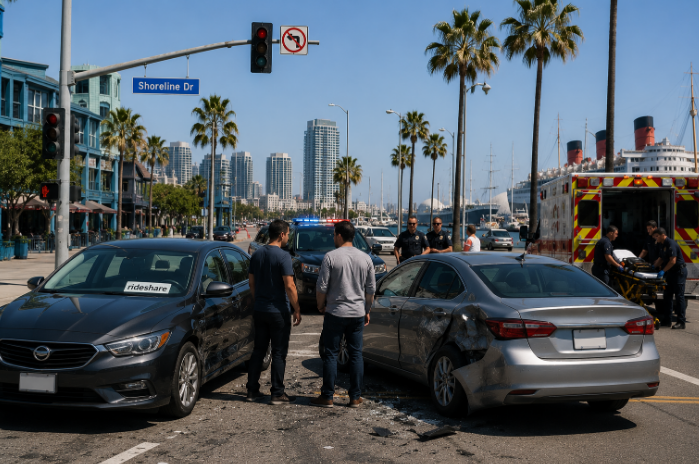
Long Beach is one of the busiest rideshare corridors in Southern California. The area around the Long Beach Convention Center and the Pine Avenue entertainment district generates heavy pickup and drop-off traffic late into the night. The stretch of Ocean Boulevard running past Shoreline Village sees high Uber and Lyft volume on weekends. Distracted drivers, sudden lane changes, and stop-and-go pickups in these dense areas create real collision risk for passengers, cyclists, and pedestrians. When something goes wrong, you need a personal injury attorney who understands exactly how rideshare liability works under California law, not just someone who handles occasional fender-benders.
Culver Legal, LLP has recovered over $1 billion for injured clients across California. Our attorneys have resolved rideshare and auto accident cases at $4 million, $3.7 million, $3.55 million, and $2.25 million. We represent clients in English and Spanish, we are available 24 hours a day, seven days a week, and we charge no fee unless we win your case.
How Rideshare Insurance Coverage Works in California
Most rideshare victims do not realize they may have a claim against Uber or Lyft’s corporate policy rather than the driver’s personal insurance. The coverage tier that applies to your case is determined by one specific fact: what was the driver’s app status at the exact moment of impact?
Under California Public Utilities Code Section 5432, the three tiers operate as follows. When the app is offline, the driver’s personal auto insurance is the only coverage available, just as it would be in any standard accident. When the app is on and the driver is waiting for a ride request, rideshare companies provide a contingent liability policy that generally covers up to $50,000 per person and $100,000 per accident for bodily injury, plus $30,000 for property damage. Once a ride has been accepted and is active, the full $1 million policy applies. Uninsured and underinsured motorist coverage up to $1 million is also available during active trips, which matters significantly if a third-party driver caused the crash and has inadequate coverage.
The dispute over which tier applies is one of the most common tactics used to reduce payouts. Uber and Lyft have access to GPS and app log data that can place the driver in any tier they choose to argue. An attorney who knows how to subpoena and interpret those records levels the playing field. This is one reason early legal intervention matters so much in rideshare cases. Evidence about the app’s status exists and can be preserved, but it requires prompt legal action to obtain it.
For a full breakdown of how California law governs rideshare accident claims, our team handles these cases statewide. You can review the complete legal framework on the rideshare accident lawyer.
Who Can Be Held Liable After a Long Beach Rideshare Accident
Rideshare cases rarely involve a single liable party. Depending on the facts, your claim may involve the rideshare driver, the rideshare company itself, another driver on the road, the owner of a defective vehicle, a government agency responsible for a dangerous road condition, or some combination of all of them. California’s pure comparative fault system allows you to pursue every liable party proportionally, which matters when any single defendant lacks the insurance coverage to fully compensate your losses.
Under California Code of Civil Procedure Section 335.1, you have two years from the date of injury to file a personal injury lawsuit. If a government entity is involved in your claim, for example, if a poorly maintained road or a city-owned vehicle contributed to the crash, you have only six months to file an administrative claim. Missing that deadline eliminates your right to pursue that defendant entirely. This is not a situation where waiting a few weeks to call an attorney is harmless.
What to Do After a Rideshare Accident in Long Beach
- Call 911 and report the accident. A police report creates an official record of the crash, the parties involved, and initial observations about fault. Request the report number before you leave the scene.
- Seek medical attention immediately. Even if you feel fine, adrenaline commonly masks injury symptoms in the hours following a collision. Emergency care at Long Beach Memorial Medical Center or urgent care establishes a medical record tied directly to the date of the accident.
- Document everything at the scene. Photograph all vehicles, the road, traffic signals, your injuries, and the surrounding area. Screenshot the rideshare app showing trip status, driver name, and vehicle details.
- Get contact information from all witnesses. Witness statements become harder to obtain with each passing day.
- Do not give a recorded statement to any insurance adjuster. This applies to Uber’s insurer, Lyft’s insurer, the driver’s insurer, and your own insurer. You are not required to give a recorded statement before speaking with an attorney.
- Contact Culver Legal before accepting any settlement offer. Early offers from rideshare insurance carriers are rarely sufficient to cover total damages, including future medical care and lost earning capacity.

What Compensation Can You Recover
California law allows injured rideshare victims to pursue both economic and non-economic damages. Economic damages cover losses that can be calculated with documentation: emergency room bills, follow-up care, surgery, physical therapy, prescription costs, lost wages during recovery, and projected future medical expenses if your injuries require ongoing treatment. Non-economic damages cover pain and suffering, emotional distress, loss of enjoyment of life, and the impact of permanent limitations on your daily routine.
California is a pure comparative fault state. If you are found partially at fault for the accident, your recovery is reduced by your percentage of fault. It is not eliminated. If your case is worth $500,000 and you are found 20% at fault, you still recover $400,000. Insurers often attempt to assign partial fault to victims, specifically to reduce the payout. Having an attorney prevents those arguments from going unchallenged.
Why Rideshare Cases in Long Beach Are Legally Complex
Standard car accident claims are complicated enough. Rideshare accidents layer additional legal disputes on top of them. Determining which insurance tier applies requires immediate access to TNC data that companies do not volunteer. Establishing whether the driver was acting within the scope of rideshare employment for purposes of corporate liability requires legal analysis specific to California Transportation Network Company law. When a third party caused the crash, UM/UIM coverage disputes with the rideshare carrier become their own litigation track entirely.
Long Beach also has jurisdictional nuances that matter. Cases filed here are heard at the Governor George Deukmejian Courthouse at 275 Magnolia Avenue. Local judicial familiarity with rideshare coverage disputes and familiarity with which arguments judges in this courthouse have accepted or rejected gives experienced attorneys a concrete advantage over out-of-area firms that handle these cases occasionally.
Frequently Asked Questions
I was a passenger in an Uber that another driver hit. Who pays my claim?
Because your ride was active, Uber’s $1 million liability policy applies regardless of who caused the crash. You may also have a claim against the at-fault third-party driver and their insurer. Both claims can be pursued simultaneously. An attorney helps ensure you recover from every available source rather than settling with just one carrier.
The rideshare driver says the app was off when the accident happened. Does that end my case?
No. App status is a factual dispute, not a fact you are required to accept at the driver’s word. Uber and Lyft maintain GPS and app log records that show exactly when and where the app was active. Those records can be subpoenaed. Insurance companies routinely dispute app status because it determines which policy pays. An attorney who requests those records early can challenge a driver’s claim about app status with documented evidence.
What if the Uber driver was at fault and their personal insurance is denying the claim?
If the app was on at any tier at the time of the crash, the rideshare company’s contingent or primary policy steps in regardless of what the driver’s personal insurer does. If the driver’s personal insurer denies because a commercial activity exclusion applies, that denial actually supports the argument that rideshare coverage was in force. This is a known coverage dispute pattern in California TNC cases. An attorney can force the issue through the correct coverage tier.
Can I file a rideshare accident claim if the accident happened near the Long Beach Convention Center?
Yes. Location does not limit your right to file. The Long Beach Convention Center area is a high-volume rideshare zone. Claims arising from pickups and drop-offs in that district, along Pine Avenue, or anywhere else in Long Beach follow the same California coverage rules regardless of where in the city the accident occurred.
How long do I have to file a rideshare accident claim in Long Beach?
Under California Code of Civil Procedure Section 335.1, you have two years from the date of injury to file a personal injury lawsuit. If a government entity, such as a city vehicle or a road maintained by the city, contributed to the crash, you have only six months to file an administrative claim. These deadlines are strict. Missing them forfeits your right to recover.
Other Services We Handle in Long Beach
- Car Accident Lawyer Long Beach
- Motorcycle Accident Lawyer Long Beach
- Truck Accident Lawyer Long Beach
- Pedestrian Accident Lawyer Long Beach
- Bicycle Accident Lawyer Long Beach
- Slip and Fall Lawyer Long Beach
- Bus Accident Lawyer Long Beach
- Brain Injury Lawyer Long Beach
- Construction Accident Lawyer Long Beach
- Dog Bite Lawyer Long Beach
- Work Injury Lawyer Long Beach
- Employment Lawyer Long Beach
- Wrongful Death Lawyer Long Beach

Serving Long Beach and Surrounding Communities
Culver Legal represents rideshare accident victims across Long Beach and the surrounding cities of Compton, Carson, Torrance, Lakewood, Signal Hill, and Paramount. Our attorneys handle cases throughout Los Angeles County and across California.
Culver Legal, LLP
5670 Wilshire Blvd., Suite 1370
Los Angeles, CA 90036
(310) 600-7881
If you were injured in a rideshare accident in Long Beach, call Culver Legal now. We take the call, review the facts, and tell you exactly where your case stands. There is no charge for the evaluation and no fee unless we win. Call Now (310) 600-7881
This content has been reviewed by the attorneys at Culver Legal, LLP, licensed to practice law in the State of California.
Attorney advertising. Prior results do not guarantee a similar outcome.
Learn more about your options for compensation by calling 310-600-7881 .
Trusted by Thousands. Millions Recovered For Our Clients
YOU Deserve the Best
Free Case Review 24/7 You Don’t Pay unless we win
CALL 310-600-7881
"*" indicates required fields
Featured Lawyers
-
David Merabi
-
Thanos Simoudis
-

Victoria Manesh
-

Michael B. Huynh
-

Michael Domingo
-
Darío C. Gómez
