182 motorcyclists were killed or injured on Long Beach streets in 2023. Adjusted for population and traffic volume, that puts Long Beach second worst of the fifteen California cities with populations over 250,000 for motorcycle casualties. The same city ranks first, meaning worst, in that group for traffic casualties overall.
If you were hurt riding here, two things tend to go wrong early, and both are fixable. The insurer opens by blaming the rider, and somebody repeats the claim that lane splitting is simply legal in California, which is not what the statute says and is not how it plays out in a fault argument.
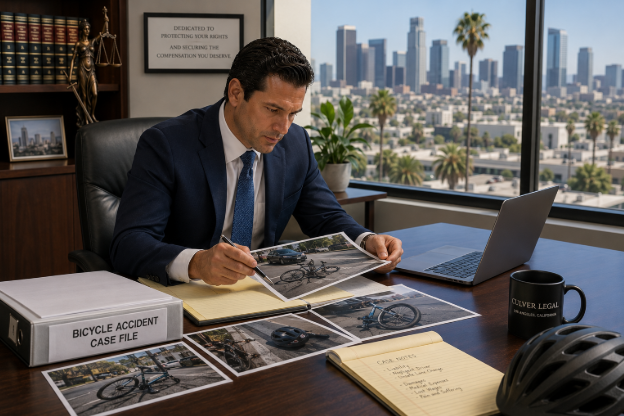
Culver Legal, LLP acts for injured riders across Long Beach on contingency, with costs advanced. There is nothing to pay up front and no fee unless we win. We advance the case costs, and if there is no recovery you are not charged those costs either. Call (310) 600-7881 at any hour.
- $2,250,000Motorcycle Accident
- $4,000,000Auto Accident
- $3,550,000Personal Injury
- $3,000,000Truck Accident
Prior results do not guarantee a similar outcome. Every case turns on its own facts.
What Does California Law Actually Say About Lane Splitting?
Less than almost everyone claims, and the gap is worth understanding because insurers exploit it.
Vehicle Code 21658.1 does two things. It defines lane splitting, as riding a two-wheeled motorcycle between rows of stopped or moving vehicles in the same lane, including on divided and undivided streets, roads and highways. And it authorizes the California Highway Patrol to develop educational guidelines for it, in consultation with other agencies.
That is the whole section. It does not say lane splitting is legal, and it does not say it is illegal. It recognizes the practice and hands the Highway Patrol a job, and that is all it does.
Why the distinction is worth money to you. An insurer will treat a splitting rider as automatically at fault, and that is wrong. A rider will assume the statute settles it in their favor, and that is also wrong. Fault still turns on the ordinary question of whether the riding was reasonable in the conditions, which means speed relative to traffic, lane position and visibility are all arguable. They are arguable, not decided, and pages that state the law flatly in either direction are giving away that argument before it starts.
Helmets, and What Happens If You Were Not Wearing One
Vehicle Code 27803 requires a safety helmet meeting federal standards for both the rider and any passenger. California has no age exemption.
Riding without one does not bar a claim. California apportions fault rather than barring recovery, so the argument an insurer runs is that the absence of a helmet contributed to the injuries rather than to the crash. That argument only reaches injuries a helmet would have affected, which is why it gets raised on head injury claims and is much weaker on everything else. It is a reduction to argue about, not an answer.
Being blamed for the crash?
Fault is apportioned in California, not assigned. A rider found 25 percent responsible still recovers 75 percent.
How Long Do You Have?
Two years from the date of the crash under Code of Civil Procedure 335.1.
Six months if a public entity is involved, under Government Code 911.2. That deadline is for a written claim. Separately, Government Code 945.4 bars a lawsuit for money damages until that claim has been presented and the entity has either acted on it or is treated as having rejected it. A claim the entity simply ignores is deemed rejected once the 45 days are up, which is what allows the lawsuit to proceed.
And presenting the claim is not the last deadline. Once the entity mails or delivers a written rejection, Government Code 945.6 gives you six months from the date of that notice to file suit. If the entity never sends a written rejection, the period is two years from when the cause of action accrued instead. A claim that is ignored therefore leaves more time than one that is formally rejected, which is the opposite of what most people expect.
This is not a rare situation on a motorcycle. A pothole, a raised utility cover, a failed signal, a road surface left unsafe after works, a city vehicle: any of those makes it a public entity case, and road surface defects injure riders in ways they never injure drivers.
In Long Beach the claim goes to the City Clerk, at 411 West Ocean Blvd, not to a risk or claims department. Death, injury to a person and damage to personal property must be filed within six months. Damage to real property has one year.
Getting the Collision Report
For a crash on a Long Beach street the report comes from the Long Beach Police Department, and collisions are handled by its Collision Investigation Detail. The fee is $29, non-refundable, per application, which is more than people usually expect. The Records Division is on 562-570-7381.
Do not file a Public Records Act request for it. The city states that collision reports are not released through that process, so a PRA request costs weeks and produces nothing.
A crash on a freeway is normally the California Highway Patrol’s rather than the city’s, and that is a different request.
Where Would the Case Be Heard?
At the Governor George Deukmejian Courthouse, 275 Magnolia. Since October 2022 the Los Angeles Superior Court has assigned newly filed personal injury cases to the judicial district where the incident arose, rather than where anyone lives or where the defendant is based. A Long Beach crash is heard in Long Beach, before a jury drawn from here.
A claim seeking more than $35,000 is an unlimited civil case.
MemorialCare Long Beach Medical Center is a Level II trauma center.
What Actually Drives the Value of a Rider’s Claim
Nobody can put a figure on a claim at the start, and a firm that offers one is guessing with your case. Four things decide it, and all four can be established early.
The medical picture once it has settled. Riders come off worse than drivers in the same collision because there is no structure between them and the road, and injuries that look defined in week one often are not. Settling before the picture is stable means settling for the least the claim will ever be worth.
The insurance available. California’s minimum liability coverage is $30,000 for injury to one person on policies issued or renewed on or after January 1, 2025, and $15,000 on older policies. A single admission and one surgery can exhaust either. Where the at-fault driver carries the minimum, your own uninsured and underinsured motorist coverage often becomes the real source of recovery. That matters more in Long Beach than in most places: the number of people killed or injured in hit-and-run collisions here, across all road users, rose from 335 in 2022 to 496 in 2023, second worst in the group, and a driver nobody identifies is a driver nobody can claim against.
The fault split. Percentages are worth real money on a serious claim, which is exactly why the insurer’s first call is about what you were doing.
Whether a public entity is involved, which is a deadline question before it is a value question.
What to Do Now
Get the medical record straight first. Adrenaline masks injuries for days, and a gap between the crash and the first medical visit is the argument an insurer builds its whole reduction around.
Photograph the road surface, not only the vehicles. On a motorcycle claim the surface is often the evidence, and it gets resurfaced.
Say nothing recorded to the other insurer. You are not obliged to give a recorded statement to another driver’s carrier, and the questions are written to produce admissions about speed and lane position.
Keep the gear. A damaged helmet, jacket and boots are physical evidence of the forces involved, and they are routinely thrown away in the first week.
Hurt riding in Long Beach?
The review costs nothing and commits you to nothing. The deadlines run either way.
Long Beach Motorcycle Accident FAQs
Should I get a lawyer for a motorcycle accident?
For anything beyond minor damage, yes, and the reason is specific rather than promotional. Rider claims are defended differently from car claims: the insurer’s opening position is usually that the rider was speeding, splitting unreasonably, or hard to see, and each of those is a fault percentage being argued for. A rider handling it alone is negotiating that split without knowing what it is worth. A review costs nothing, so the question is only whether the claim is worth pursuing, and where it is not we will say so.
Is it better to settle with insurance or get a lawyer?
An early offer arrives before anyone knows what the injury will cost, which is precisely why it arrives early. It is not always wrong to take one, but it should be a decision made with the medical picture in front of you rather than in the first few weeks, because a settlement is final and a claim cannot be reopened when treatment turns out to be longer than expected.
Can I still claim if I was lane splitting?
Yes. Vehicle Code 21658.1 defines lane splitting and directs the Highway Patrol to develop educational guidelines for it. What it does not do is settle fault either way, in either direction. Whether your riding was reasonable in the conditions remains arguable on the facts, and California reduces recovery by your share of the blame rather than barring it, so even a rider carrying part of the responsibility still recovers.
What if I was not wearing a helmet?
You can still claim. Vehicle Code 27803 requires a helmet, and an insurer will argue the absence of one made the injuries worse, but that argument only reaches injuries a helmet would have affected. It is a reduction to be argued about, not a bar to recovery.
What if the driver left the scene?
That is a common situation in Long Beach and it does not end the claim. The number of people killed or injured in hit-and-run collisions here, across all road users, rose from 335 to 496 in a single year. Where the driver is never identified, the route is usually the uninsured motorist coverage on your own policy, which is what that coverage exists for and which does not raise your premium for making a claim you did not cause.
What if a road defect caused the crash?
Then it is a claim against a public entity, and the deadline changes from two years to six months for a written claim under Government Code 911.2, filed in Long Beach with the City Clerk. Photograph the defect immediately. Roads get resurfaced, and once the surface is repaired the evidence that proved the case is gone.
Contact a Culver Legal Long Beach Motorcycle Accident Lawyer
Long Beach ranks second worst of California’s largest cities for motorcycle casualties and first for traffic casualties overall. If a road defect or a public vehicle was involved, your deadline is six months rather than two years. Call (310) 600-7881 at any hour. The review costs nothing.
Attorney Advertising. Prior results do not guarantee a similar outcome. Culver Legal, LLP is a California law firm. The information on this page is for general informational purposes and does not constitute legal advice.