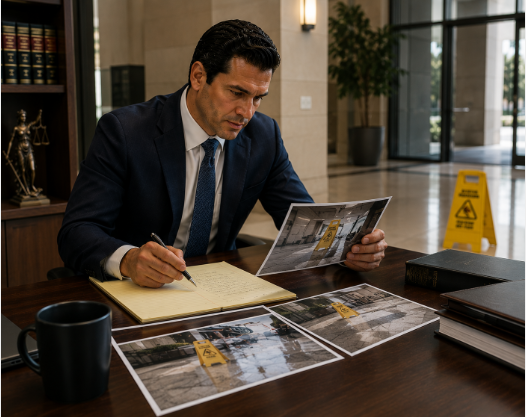
These cases are harder than collision cases, and the reason is specific rather than general. In a crash the other driver did something. In a fall the property owner usually did nothing, and doing nothing is only actionable if they knew about the hazard or should have known.
That is the notice question. It is where these claims are won and lost, and the evidence that answers it belongs to the other side.
Culver Legal, LLP represents injured people across the Central Valley from an office at 1690 W Shaw Avenue, Suite 220 in Fresno. We work on contingency and advance the costs of the case, so there is nothing to pay up front and no fee unless we win. If there is no recovery, you are not charged those costs either. Call (310) 600-7881 at any hour.
What Do You Actually Have to Prove?
Four things, and they are the same four in every negligence claim:
1. Duty. The property owner or occupier owed you a duty of reasonable care. In California this generally applies to anyone lawfully on the property, including customers and visitors. 2. Breach. They failed to meet it, by creating a hazard, failing to fix one, or failing to warn. 3. Causation. That failure caused your injury, rather than something else. 4. Damages. You suffered actual harm, which is what the claim compensates.
Breach is where premises cases live, and it is not established just by proving the hazard existed. It requires showing the owner knew about it, or should have known and had a reasonable opportunity to deal with it. A spill thirty seconds old is a different case from one that had been there two hours.
What Does Notice Actually Look Like in Evidence?
Almost never a witness saying “they knew”. It is documentary, and it is held by the defendant:
- Inspection logs and sweep sheets, which show how often the area was checked and whether the schedule was kept on the day
- Cleaning and maintenance records
- Prior complaints or incident reports about the same hazard or the same spot
- Surveillance footage, which establishes how long the hazard was there
- Work orders for a repair that was requested and not carried out
Every one of those is on a retention schedule. Footage in particular is routinely overwritten within days on a loop, and once it is gone the question of how long the hazard had been there usually cannot be answered at all. That is the single reason to act early on a premises claim, and it has nothing to do with how the injury feels.
Cases that look weak often become strong once those records are produced. Cases that feel obvious fail because nobody asked for them in time.
Was there a camera where you fell?
Footage is usually overwritten within days. A preservation request has to go out before it does.

Did You Fall on Public Property?
Then the deadline changes and it changes sharply, and this is the mistake that ends more premises claims than any argument about notice.
A claim against a public entity runs under the Government Claims Act: a written claim within six months under Government Code 911.2, not the ordinary two years, and no lawsuit until it has been presented.
For a claim against the City of Fresno, that goes to the Risk Management Division, 2600 Fresno Street, Room 1030. Not to the City Clerk. And the city requires claims to be filed in duplicate, which is its own published instruction and is trivial to comply with once you know it.
Establish which body owns the property before filing anywhere. A city park, a county building, a school campus and a state facility are four separate entities with four separate processes, and a claim presented to the wrong one has not been presented at all.
The sidewalk rule most people have backwards
A fall on a public sidewalk feels like a claim against the city, and frequently it is not. Streets and Highways Code 5610 places the duty to maintain the sidewalk fronting a property on the owner of that property, not on the city.
That can move the claim from a six-month government deadline to an ordinary two-year one against a private owner, or mean there are two potential defendants rather than one. It is worth establishing early, because it changes the deadline you are working to. Where there is any doubt, work to the shorter one.
What About “You Should Have Been Looking Where You Were Going”?
Expect it, and know what it is worth.
California is a pure comparative fault state. If you are found partly responsible, your recovery is reduced by that percentage rather than eliminated. Somebody found 25% at fault recovers 75%.
An open and obvious hazard can reduce a claim. It does not automatically defeat one, particularly where the owner should have anticipated that people would encounter it anyway, which is exactly the situation in a store aisle or a parking lot.
Where Will You Be Treated, and Where Would the Case Be Heard?
The serious injuries in this region go to Community Regional Medical Center, 2823 Fresno Street, which describes itself as the only Level I trauma center between Los Angeles and Sacramento.
Falls produce a particular version of the medical-record problem. People decline the ambulance, go home, and see somebody days later when the pain has not settled. The gap between the fall and the first record is the first thing an insurer points at. The answer is a record made as soon as you realize something is wrong rather than a later account of how you felt at the time. Head injury is easy to miss this way, and a traumatic brain injury can declare itself over the following week.
A premises claim seeking more than $35,000 is an unlimited civil case, filed at the B. F. Sisk Courthouse, 1130 O Street, and heard in Fresno County before a Fresno County jury.
Did you fall on city property?
Six months, not two years, and Fresno wants the claim in duplicate. Do not let the deadline pass while you find that out.
Why Do Fresno Clients Choose Culver Legal?
We are in Fresno, at 1690 W Shaw Avenue, Suite 220, and where you cannot travel we come to you.
Our team speaks Spanish, Farsi, Filipino, Hindi, Mandarin and Korean.
The economics are simple. Contingency, costs advanced, nothing up front and no fee unless we win. We advance the case costs, and if there is no recovery you are not charged those costs either. Culver Legal has recovered $200 Million and counting, and the phone is answered 24 hours a day.
Fresno Slip and Fall FAQs
What are the four proofs of negligence?
Duty, breach, causation and damages. The owner owed you a duty of reasonable care; they breached it; the breach caused your injury; and you suffered actual harm. In a premises case the argument is almost always about breach, because breach requires more than showing the hazard existed. It requires showing the owner knew about it, or should have known and had a reasonable chance to deal with it, which is the notice question.
How hard is it to win a slip and fall case?
Harder than a collision case, for the reason above: the owner usually did nothing, and doing nothing is only actionable with notice. What decides it is documentary evidence held by the other side, inspection logs, cleaning schedules, prior complaints and footage, all of which are on retention schedules. Cases that look weak often strengthen once those are produced, and cases that feel obvious fail because nobody asked in time.
How long do I have to sue after a slip and fall?
Two years from the date of injury under Code of Civil Procedure 335.1. If you fell on public property, a written claim must be presented within six months, which is the deadline most often missed. Where you are not sure whether the property was public, work to the six months.
I fell on a sidewalk. Do I sue the city?
Not necessarily. California places the duty to maintain the sidewalk fronting a property on the owner of that property rather than on the city. Depending on what caused the fall and who controlled it, the claim may be against a private owner on a two-year limit, against the public entity on a six-month claim, or against both. Work to the shorter deadline while that is established.
The store says I should have seen it. Does that end my claim?
No. California reduces a recovery in proportion to fault rather than barring it, so even a finding that you were partly careless leaves the claim intact at a lower figure. An open and obvious hazard can reduce a claim, and it does not automatically defeat one, particularly where the owner should have expected people to encounter it anyway.
I am undocumented. Can I bring a claim without putting myself at risk?
Yes, and the protection is stronger than most people expect. Under Evidence Code 351.2, added by AB 2159, evidence of a person’s immigration status is not admissible in a civil action for personal injury or wrongful death, and discovery into it is not permitted either. It cannot be raised at trial and it cannot be asked about beforehand. It is not a question we ask you, and it is not a question the other side gets to ask.
Contact a Culver Legal Fresno Slip and Fall Lawyer
The records that prove a premises claim belong to the other side and are discarded on a schedule. If you were hurt in a fall anywhere in Fresno or the surrounding Central Valley, reach us at (310) 600-7881 at any hour, or at 1690 W Shaw Avenue, Suite 220. The review costs nothing.
Attorney Advertising. Prior results do not guarantee a similar outcome. Culver Legal, LLP is a California law firm. The information on this page is for general informational purposes and does not constitute legal advice.