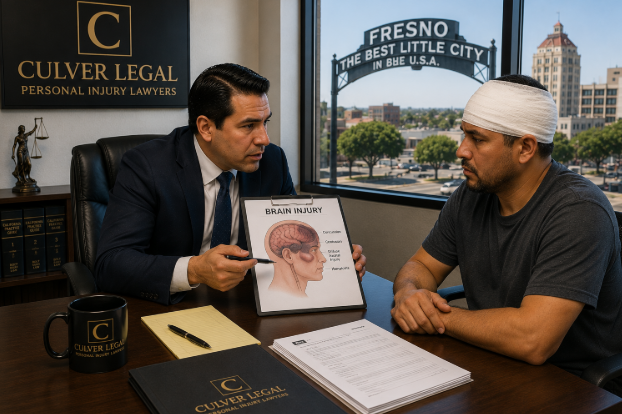
A brain injury does not always announce itself. You may have walked away from the crash feeling shaken but basically fine. Days later the headaches arrive, then the trouble holding a thought, then the discovery that a full day at work is no longer possible. A traumatic brain injury can dismantle a life quietly, before any doctor has put a name to it.
The hard part of these claims is not that the injury is invisible. It is that the evidence which proves it is created early, by other people, and has to be asked for before it is filed away.
Culver Legal, LLP represents brain injury clients across the Central Valley from an office at 1690 W Shaw Avenue, Suite 220 in Fresno. We work on contingency and advance the costs of the case, so there is nothing to pay up front and no fee unless we win. If there is no recovery, you are not charged those costs either. Call (310) 600-7881 at any hour.
What Counts as a Traumatic Brain Injury?
Traumatic brain injuries run from mild concussion to injuries involving loss of consciousness, skull fracture or permanent cognitive change. The Centers for Disease Control and Prevention reports that falls and motor vehicle crashes are the two leading causes of TBI hospitalizations among adults in the United States.
Injuries that can support a claim include:
- Concussion and post-concussion syndrome
- Diffuse axonal injury
- Contusion and intracerebral hemorrhage
- Subdural and epidural hematoma
- Skull fracture with brain involvement
- Hypoxic brain injury from oxygen deprivation
- Acquired brain injury from trauma to the neck or spine affecting blood flow
A mild TBI is not a small one. Chronic headaches, sensitivity to light and sound, disrupted sleep, mood change, memory gaps and slower processing all affect whether you can work, drive and look after your family. Those are compensable, and they are frequently the part of the claim that carries the most value and gets documented the least.
Why Are These Claims So Hard to Prove?
Three things make brain injury claims different from the rest of personal injury, and an insurer will use all three.
Early imaging often looks normal. A standard CT scan in an emergency room is looking for the things that need treating in the next hour, principally bleeding and swelling. It can come back clear while a serious concussion or diffuse axonal injury is present. Adjusters treat a normal scan as an absence of injury. What answers it is different evidence: neuropsychological testing, specialist evaluation, and imaging chosen for the question rather than for the emergency.
Symptoms are delayed. Cognitive change, personality shift and post-concussion symptoms often take days or weeks to appear. That delay is exactly the window an insurer uses to argue the symptoms belong to something else.
Your medical history becomes a target. A prior concussion, a mental health diagnosis or any neurological condition will be raised against causation. California law does not allow that to defeat the claim. Under the eggshell plaintiff doctrine, a defendant takes you as they find you. If the incident made a pre-existing condition worse, the worsening is recoverable.
Did the scan come back normal?
Emergency imaging answers the emergency question, not every question. That is not the end of the claim.
Where Are the Records, and Which Ones Actually Matter?
This is the part of a brain injury claim that is won or lost administratively, and it starts with where the ambulance went.
Community Regional Medical Center, 2823 Fresno Street, describes itself as the only Level I trauma center between Los Angeles and Sacramento, verified at that level by the American College of Surgeons and staffed around the clock by surgeons board certified in surgery and critical care. If the injury was serious anywhere in this part of the state, that is where the patient went.
Three documents do the work, and none of them is the discharge summary.
- The trauma activation record, which captures how the team graded the patient on arrival. It is the closest thing to a contemporaneous measurement of how bad it was.
- The imaging and the radiologist’s own report, rather than the sentence somebody read out in a corridor.
- The first responder narrative, which is often the only account of how the head was struck and whether consciousness was lost.
Those sit with different custodians, are requested separately, and none of them arrives automatically in the packet an insurer asks you to sign a release for.
Where the family is doing the collecting, which is common when the injured person cannot, start one file and keep everything, including ambulance paperwork. Write down what you notice in the first month. Contemporaneous observations by people who know the person, about memory, temper, sleep and tolerance for noise, are evidence, and nobody else is in a position to make them.
What Kind of Incident Caused It?
A brain injury claim runs on the same law as the incident that caused it, so the route into the case matters:
- A car accident or a truck accident, where the mechanism is usually well documented
- A motorcycle accident or a bicycle accident, where the rider is often the only person at the scene unable to give an account
- Being struck while walking, which produces the most severe head injuries because there is nothing between a person and the vehicle
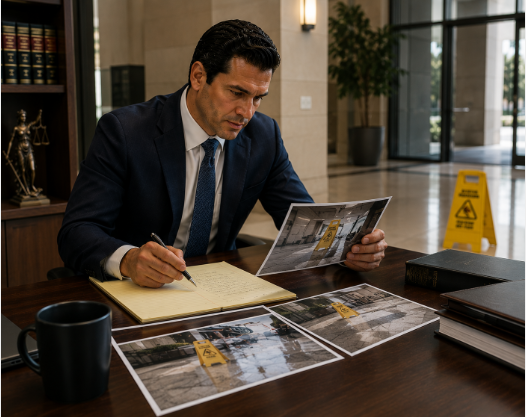
- A fall on property somebody else was responsible for
- Where the injury proves fatal, a wrongful death claim instead, brought by the people the statute allows rather than by whoever was closest
How Long Do You Have, and What If a Public Body Is Involved?
Two years from the date of injury under Code of Civil Procedure 335.1.
Six months to present a written claim if a public entity is involved, under Government Code 911.2, and until that is done there is no lawsuit to bring. For a claim against the City of Fresno that goes to the Risk Management Division, 2600 Fresno Street, Room 1030, and the city requires claims in duplicate. That is a small procedural point with a large consequence inside a six-month window.
This is the deadline most likely to be missed on a brain injury, because the injury is often declaring itself slowly at exactly the time the clock is running fastest. Where the injured person cannot act for themselves, somebody else has to, and waiting for a clear prognosis is not a reason the deadline will forgive.
Code of Civil Procedure 352 pauses the ordinary period for an injured person under 18. The six-month government claim is not paused the same way.
Where Would the Case Be Heard?
At the B. F. Sisk Courthouse, 1130 O Street, which is where Fresno County hears unlimited civil cases. A brain injury claim is an unlimited civil case by definition.
Venue matters more here than on most pages. The damages in a brain injury case are argued rather than invoiced: a jury is being asked to put a value on a change in somebody that does not appear on a scan and that the person themselves may struggle to describe. How that argument is built for a Fresno County jury is a large part of the case, and it is why the documentation above is worth chasing early rather than reconstructing later.
Has an insurer offered to settle already?
A brain injury cannot be valued before the lasting effects are known. A release signed early cannot be reopened.
Why Do Fresno Clients Choose Culver Legal?
We are in Fresno, at 1690 W Shaw Avenue, Suite 220, and where somebody cannot travel we come to them. On a brain injury that is not a courtesy; it is often the only way the first meeting happens.
Our team speaks Spanish, Farsi, Filipino, Hindi, Mandarin and Korean. Describing cognitive symptoms is hard in your first language and harder in your second.
The economics are simple. Contingency, costs advanced, nothing up front and no fee unless we win. We advance the case costs, and if there is no recovery you are not charged those costs either. Culver Legal has recovered $200 Million and counting, and the phone is answered 24 hours a day.
Fresno Brain Injury FAQs
Can you sue for brain damage?
Yes, where somebody else’s negligence caused it. The claim runs on the underlying incident, so a brain injury from a collision is pursued as a motor vehicle claim and one from a fall as a premises claim. What makes it distinct is the proof: the injury has to be documented through testing and specialist evaluation rather than assumed from the mechanism, and the damages reach into work, relationships and daily function rather than stopping at medical bills.
How long do brain injury cases take to settle?
Longer than most claims, and for a medical reason rather than a tactical one. The value turns on what the lasting effects are, and that is not known early. Settling while recovery is still changing means settling on a guess, and a settlement cannot be reopened when the guess turns out low. The two-year deadline usually leaves room for that. The six-month government claim does not, and it has to be presented on time regardless of how unresolved the medical picture is.
The CT scan was normal. Does that mean there is no brain injury?
No, and this is the most common reason a real claim gets abandoned. Emergency imaging is looking for what needs treating immediately, principally bleeding and swelling, and a normal result answers that question. It is not designed to rule out the diffuse damage that shows up later as trouble with memory, concentration, sleep and mood. What establishes those is the record built over the following weeks, together with what the people around you noticed.
I had a concussion years ago. Does that ruin my claim?
No. Under the eggshell plaintiff doctrine a defendant takes you as they find you, so a pre-existing condition does not defeat the claim. If the incident made it worse, the worsening is what you recover for. Expect the history to be raised anyway, and expect the argument to be that everything you are experiencing was already there. Answering it is a documentation exercise, which is why the early records matter so much.
Who can bring the claim if the injured person cannot?
Where somebody lacks the capacity to conduct their own case, California provides for it to be brought on their behalf through a representative appointed for the purpose. The practical point is that the deadlines keep running while that is arranged, particularly the six-month government claim, so it is worth starting the conversation early rather than waiting for capacity to be formally resolved.
What should we be doing in the first month?
Keeping records that nobody else will make. Note what you observe about memory, mood, sleep, noise tolerance and fatigue, dated, in plain language. Keep every discharge sheet and appointment card. Get the person seen by their own doctor rather than relying on the emergency visit alone, because the record of symptoms appearing over time is what connects them to the incident.
I am undocumented. Can I bring a claim without putting myself at risk?
Yes, and the protection is stronger than most people expect. Under Evidence Code 351.2, added by AB 2159, evidence of a person’s immigration status is not admissible in a civil action for personal injury or wrongful death, and discovery into it is not permitted either. It cannot be raised at trial and it cannot be asked about beforehand. It is not a question we ask you, and it is not a question the other side gets to ask.
Contact a Culver Legal Fresno Brain Injury Lawyer
The records that prove a brain injury are made in the first hours and the first weeks, by people who will file them and move on. If you or someone in your family was hurt anywhere in Fresno or the surrounding Central Valley, reach us at (310) 600-7881 at any hour, or at 1690 W Shaw Avenue, Suite 220. The review costs nothing.
Attorney Advertising. Prior results do not guarantee a similar outcome. Culver Legal, LLP is a California law firm. The information on this page is for general informational purposes and does not constitute legal advice.