A fall is the injury people are most embarrassed to make a claim about, and it is also the one where the evidence disappears fastest. The spill gets mopped within the hour. The incident report gets filed somewhere you cannot reach. By the time anyone asks how long the hazard had been there, the only person who remembers is the one being asked.
These cases turn on notice, not on the fall. The question is not whether you fell or whether it hurt. It is whether the person responsible for the property knew about the hazard, or should have known about it, and had time to do something. That single question decides most premises claims, and almost everything worth collecting in the first week goes to answering it.
Culver Legal has recovered $200 Million and counting for injured people in California. We work on contingency, we advance the costs of the case, and there is no fee unless we win. If there is no recovery, you are not charged those costs either. Call (310) 600-7881 at any hour, including tonight.
Who Is Responsible for the Place You Fell?
Not always who you would expect, and the answer changes your deadline as well as your defendant.
A business or private property owner. The ordinary case, governed by Civil Code 1714, under which everyone is responsible for injury caused by their want of ordinary care. Two years to file.
The property fronting a public sidewalk, not the city. This surprises almost everyone. Streets and Highways Code 5610 puts the duty on “the owners of lots or portions of lots fronting on any portion of a public street or place”, who “shall maintain any sidewalk in such condition that the sidewalk will not endanger persons or property”. A raised slab outside a shop is the shop’s problem before it is the city’s.
A public entity, where the property is genuinely public. A county building, a school, a transit facility, a park. Government Code 835 governs this and the deadline drops to six months.
A landlord rather than a tenant, or both, depending on who controlled the area and who was responsible for maintaining it under the lease.
An employer’s site. A fall at work is usually also a work injury claim, and where the property belonged to somebody other than your employer both claims run at once. On an active job site the same fall is a construction accident claim, where the question becomes which contractor controlled the area.
A transit operator. A fall while boarding, riding or getting off a bus is a premises-style claim against a carrier that owes its passengers utmost care rather than ordinary care, and against Golden Empire Transit it runs on six months. Both reported Court of Appeal decisions involving that district were falls, and a claim against a transit operator runs on that higher duty.
What “Notice” Actually Means
Two kinds, and the second is where these cases are won.
Actual notice. Somebody told them, or an employee saw it. A prior complaint, a maintenance request, an earlier incident at the same spot.
Constructive notice, which is the ordinary route and the harder one. The hazard was there long enough, and was obvious enough, that a reasonable owner inspecting properly would have found it. On public property Government Code 835.2 puts it in exactly those terms: the condition must have “existed for such a period of time and was of such an obvious nature that the public entity, in the exercise of due care, should have discovered the condition and its dangerous character”.
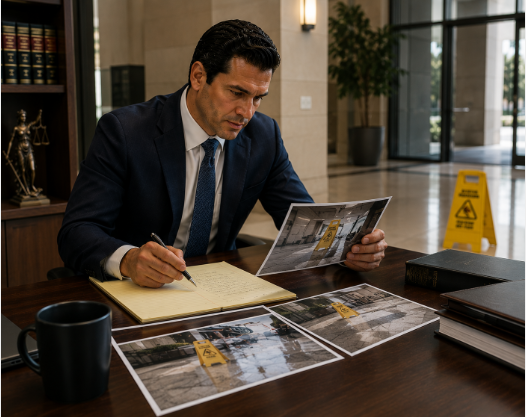
So the evidence that matters is about time, not about the fall. Inspection logs and sweep sheets showing when the area was last checked. Prior complaints and prior incidents at the same location. Surveillance footage, which shows how long a spill sat there and which is overwritten on a cycle measured in days. Photographs of a hazard that is plainly not new: a worn edge, a settled slab, a stain around a leak.
Almost all of that is held by the defendant, and almost none of it is preserved unless somebody asks in writing.
How long had that hazard been there?
That, not the fall, is what decides a premises case. The footage that answers it is overwritten within days.
“You Should Have Been Looking Where You Were Going”
The standard defense, and it does not do what people assume.
California reduces recovery in proportion to fault rather than barring it. If a claim is worth $300,000 and you are found 30 percent responsible for not noticing, you recover $210,000. Being partly at fault lowers the number and does not remove the claim.
An open and obvious hazard is not automatically a complete defense either. The question remains whether the owner acted reasonably, and there are places where a hazard is foreseeable precisely because people will be looking elsewhere: a step in a shop aisle, a wet floor by an entrance on a rainy day, a change in level in a poorly lit stairwell.
What genuinely hurts a claim is different and more mundane. A gap between the fall and the first medical record is the single most reliable argument that you were not badly hurt. So is a fall that was never reported to anyone at the premises, because it leaves nothing to date the hazard against.
The same reasoning about who maintains a public sidewalk decides a different question for someone struck by a vehicle while walking, where the defendant is usually the driver rather than the property, but the six-month rule arrives by the same route when the roadway itself was at fault.
What Are These Injuries Worth?
Falls produce a narrow set of serious injuries and the valuation follows them.
- Fractures, particularly wrist, hip and ankle, which on an older person can change how independently they live
- Head injuries. Somebody who struck their head and got up may have a brain injury that the emergency record does not capture, because a clear scan answers the emergency question rather than every question
- Back and shoulder injuries, often needing staged treatment over months
- Lost income, and separately lost earning capacity where you cannot return to the same work
Where a fall is fatal, and on stairs or from height that happens, the family’s claim is a wrongful death claim, and against a public defendant the six-month rule applies to it too.
How Long Do I Have to File?
Two years from the date of injury against a private owner or business, under Code of Civil Procedure 335.1.
Six months to present a written claim to a public entity, under Government Code 911.2, before any lawsuit against it is possible. On a fall this comes up constantly, because a sidewalk, a county building or a transit stop does not look different from private property at the moment you go down on it.
Injured children. Code of Civil Procedure 352 pauses the ordinary limitation period while an injured person is under 18. The six-month government claim rule is not paused in the same way.
Did you fall on a sidewalk and assume it was the city’s?
Streets and Highways Code 5610 puts that duty on the property fronting it. Different defendant, different deadline.
If You Fell on City Property, Where Does the Claim Go?
This is the question that decides these cases in Bakersfield, and getting it wrong is usually fatal to the claim rather than merely inconvenient.
A fall on property belonging to a public entity runs under the Government Claims Act, so a written claim must be presented within six months under Government Code 911.2, not the two years people assume. Until that claim has been presented there is no lawsuit to bring.
For a claim against the City of Bakersfield, that goes to the City Clerk, 1600 Truxtun Avenue, 1st floor. The Clerk’s office is the department that accepts liability claims and service of legal documents. The claim is then handled by the city’s Risk Management division, on the 5th floor of the same building. So it is filed downstairs and answered upstairs, which is a small thing to know and a useful one when you are trying to find out what happened to a claim you sent in.
But confirm whose property it was before you file anywhere. A city park, a county building, a school campus and a state facility are four different public entities with four separate claims processes, and a claim presented to the wrong one is not a claim presented. The same trap runs through the bus pages on this site, where three public operators serve one city and none of them is the City of Bakersfield.
The sidewalk exception most people get backwards
A fall on a public sidewalk feels like a claim against the city, and often it is not. Streets and Highways Code 5610 places the duty to maintain the sidewalk fronting a property on the owner of that property, not on the city. That can move the claim from a six-month government deadline to an ordinary two-year one against a private owner, or it can mean there are two potential defendants rather than one. It is worth establishing early, because the answer changes the deadline you are working to.
Where Will the Case Be Heard, and Where Will I Be Treated?
A slip and fall claim seeking more than $35,000 is an unlimited civil case, filed at the Metro Justice Building, 1215 Truxtun Avenue and heard in Kern County before a Kern County jury. Limited civil cases up to $35,000 go to the Metropolitan Division and the regional courts around the county.
The most serious injuries in the county are taken to Kern Medical, 1700 Mount Vernon Avenue, a Level II trauma center designated in 2001 and re-verified by the American College of Surgeons Committee on Trauma. Falls produce a particular version of the medical-record problem: people frequently decline the ambulance, go home, and only see somebody days later when the pain has not gone. The gap between the fall and the first record is the first thing an insurer will point at, and the way to answer it is a record made as soon as you realize something is wrong rather than a later account of how you felt at the time.
Why Bakersfield Clients Choose Culver Legal
We come to you. If you are in the hospital, at home and unable to drive, or a long way out in the county, we will meet you where you are. A broken hip is a reason for us to travel, not for you to.
Our team speaks Spanish, Farsi, Filipino, Hindi, Mandarin and Korean. Explaining your own accident in your own words is not a convenience.
The economics are simple. The firm works on contingency and advances the costs of the case, so there is nothing to pay up front and no fee unless we win. We advance the case costs, and if there is no recovery you are not charged those costs either. Culver Legal has recovered $200 Million and counting, and answers the phone 24 hours a day.
Bakersfield Slip and Fall FAQs
I fell on a public sidewalk. Do I claim against the city?
Often not. Streets and Highways Code 5610 puts the duty to maintain a sidewalk on the owner of the property fronting it, so a raised slab outside a business is usually that business’s responsibility. That matters twice over, because a claim against a private owner runs on two years while a claim against a public entity has to be presented in writing within six months.
Nobody at the store would give me an incident report. Does that hurt my case?
It is common and it is not fatal. Photographs taken at the time, the names of anyone who saw it, the receipt showing you were there, and a medical record dated close to the fall all do similar work. What the store holds, including footage and inspection logs, can be obtained, but footage is overwritten quickly.
They say the hazard was obvious. Does that defeat my claim?
That is an argument about your share of fault, not an answer to the claim. California reduces recovery in proportion to fault rather than barring it, and the question of whether the owner acted reasonably remains live regardless.
How long does the property owner have to keep the video?
There is no rule that requires them to keep it for you, and most systems overwrite on a loop measured in days or a few weeks. A written demand to preserve it, sent early, is what turns later destruction into something the court can take a view on.
I am undocumented. Can I bring a claim without putting myself at risk?
Yes, and the protection is stronger than most people expect. Under Evidence Code 351.2, added by AB 2159, evidence of a person’s immigration status is not admissible in a civil action for personal injury or wrongful death, and discovery into it is not permitted either.
How hard is it to win a slip and fall case?
Harder than a collision case, and the reason is specific rather than general. In a crash, the other driver did something. In a fall, the property owner usually did nothing, and doing nothing is only actionable if they knew about the hazard or should have known about it. That is the notice question, and it is where these cases are won and lost. The evidence that answers it is not about your fall at all: inspection logs, cleaning schedules, maintenance records, prior complaints about the same spot, and the footage showing how long the hazard had been there. Every one of those is held by the other side and every one is on a retention schedule. Cases that look weak often become strong once those records are produced, and cases that feel obvious can fail because nobody asked for them in time.
I fell on a sidewalk. Do I sue the city?
Not necessarily, and it is worth checking before you assume the six-month government deadline applies to you. California places the duty to maintain the sidewalk in front of a property on the owner of that property rather than on the city. Depending on what caused the fall and who controlled it, the claim may be against a private owner on the ordinary two-year limit, against the public entity on a six-month claim, or against both. The safe approach where there is any doubt is to work to the shorter deadline while the answer is established.
Contact a Culver Legal Bakersfield Slip and Fall Lawyer
The thing that proves one of these cases is a record of how long the hazard sat there, and it is held by the person you are claiming against. If you fell anywhere in Bakersfield or Kern County, reach us at (310) 600-7881, at any hour. The review costs nothing.
Attorney Advertising. Prior results do not guarantee a similar outcome. Culver Legal, LLP is a California law firm. The information on this page is for general informational purposes and does not constitute legal advice.