 Skip to Content
Serving All of California - Hablamos Espanol
Serving All of California 24/7
Truck Accident Lawyer Bakersfield
Bakersfield sits at a major crossroads for commercial freight. Highway 99, Interstate 5, and State Route 58 carry thousands of 18-wheelers through Kern County every day, connecting Southern California ports to Central Valley agricultural shippers and beyond. When one of those trucks collides with a passenger vehicle near the Westside Parkway interchange or along the Golden State Highway corridor, the injuries are rarely minor. If you or someone you love was hurt in a commercial truck crash here, you have the right to pursue full compensation from every party whose negligence contributed to what happened.

Truck accident cases in Bakersfield involve layers of legal complexity that standard car accident claims do not. The trucking company, the cargo loader, the truck manufacturer, the maintenance contractor, and the driver may each carry a share of liability. Federal Motor Carrier Safety Administration regulations govern how trucks must be operated, maintained, and logged. Evidence from the truck’s electronic logging device and onboard black box can be destroyed or overwritten within days if no legal hold is issued. The window to act is narrow. Culver Legal, LLP represents injured victims across Kern County and recovers maximum compensation from every responsible party.
Why Truck Crashes in Bakersfield Are Different
Agricultural freight moves in and out of Kern County year-round. Produce, oil field equipment, and construction materials travel heavy routes through the city’s industrial corridors and residential streets alike. The drivers behind those loads may be fatigued from hours-of-service violations, operating under pressure from dispatch to meet unrealistic schedules, or driving trucks that have not been properly maintained. A loaded semi can weigh up to 80,000 pounds. At highway speed, the stopping distance alone dwarfs what most drivers expect. When something goes wrong, passenger vehicles absorb the consequences.
Under federal FMCSA regulations, trucking companies are required to maintain driver qualification files, inspection records, and electronic logging device data. Those records are the foundation of many truck accident claims. Trucking companies know this. Their insurers often begin damage control the same day a serious crash occurs, sending adjusters and sometimes accident reconstruction teams to the scene before the injured party has spoken with a lawyer. Do not give a recorded statement. Do not accept an early settlement offer. Call Culver Legal first.
If you want to understand how California’s truck accident law applies to your situation, including how liability is assigned across multiple defendants, that page walks through the full legal framework.
Common Causes of Truck Accidents on Bakersfield Roads
- Driver fatigue and hours-of-service violations on long Central Valley hauls
- Improperly secured or overweight cargo on freight routes off Highway 99
- Brake failure or deferred maintenance on high-mileage commercial vehicles
- Distracted or impaired truck drivers in residential corridors near Downtown Bakersfield
- Wide-turn collisions at intersections throughout the city’s commercial districts
- Blind-spot crashes during lane changes on I-5 and SR-58
- Jackknife accidents during sudden stops or adverse road conditions
What to Do After a Truck Accident in Bakersfield
- Call 911 immediately. Get a police report filed at the scene. The Kern County Sheriff or the Bakersfield Police Department will document the crash. Ask for the report number before you leave.
- Seek medical attention that day. Even if you feel able to walk away, internal injuries and traumatic brain injuries may not produce symptoms for hours or days. Get evaluated at Bakersfield Memorial Hospital or another emergency facility before symptoms worsen.
- Document everything at the scene. Photograph the truck’s license plate, DOT number, company markings, your vehicle, road conditions, skid marks, and your injuries. Record a short video describing what happened while it is fresh.
- Do not speak to the trucking company or its insurer. Their representatives may call quickly and present themselves as trying to help. They are not. Anything you say will be used to reduce or deny your claim.
- Preserve all medical records from your first visit forward. A gap in treatment is one of the first tools insurers use to minimize injury claims.
- Contact Culver Legal as early as possible. Federal evidence, like ELD data and black box data, has a short retention window. Sending a legal hold letter to the trucking company must happen fast.
Injuries Common in Kern County Truck Accidents
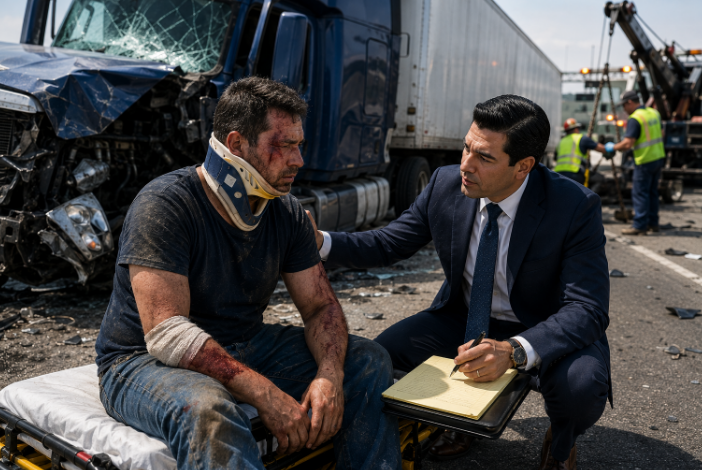
The force generated in a commercial truck collision routinely produces injuries that require months or years of treatment. Spinal fractures, herniated discs, traumatic brain injuries, crush injuries to limbs, internal organ damage, and severe burns are among the most serious. Many victims require surgery, extended rehabilitation, and ongoing pain management. Some injuries leave permanent limitations that affect the ability to work or perform basic daily activities. Compensation in truck accident cases must account not just for current medical bills but for the full cost of future care, lost earning capacity, and the non-economic toll of permanent impairment.
California Law and Your Truck Accident Claim
Under California Code of Civil Procedure Section 335.1, you have two years from the date of injury to file a personal injury lawsuit. If a government entity is involved, a six-month administrative claim deadline applies instead. Missing either deadline ends your right to recover.
California is a pure comparative fault state. If you are found partially responsible for the crash, your recovery is reduced by your percentage of fault, not eliminated. If your case is worth $1,000,000 and you are found 20% at fault, you still recover $800,000. Do not let an insurance adjuster convince you that shared fault means no case.
FMCSA regulations add a federal layer to California truck accident claims. Hours-of-service limits, mandatory rest periods, vehicle inspection requirements, and cargo securement standards all apply. A violation of any federal rule is evidence of negligence per se, meaning the violation itself establishes a breach of the duty of care. Culver Legal investigates every applicable federal and state standard as part of building your claim.
Electronic logging device data, driver qualification files, and maintenance records are not kept indefinitely. Trucking companies may legally dispose of certain records within defined windows. Early legal intervention is not a formality. It is the difference between a complete evidentiary record and a case built on gaps.
Who Can Be Held Liable in a Bakersfield Truck Accident
Fault in commercial truck crashes rarely falls on one party alone. Culver Legal investigates all potentially liable parties, which may include the truck driver, the motor carrier that employed or contracted the driver, the company responsible for loading and securing cargo, the entity that owned the truck if different from the carrier, and any manufacturer of defective parts that contributed to the crash. When multiple defendants share liability, total compensation can be substantially higher than a single-defendant claim. Every party must be properly identified and pursued before the statute of limitations expires.
What Compensation Can You Recover
Bakersfield truck accident victims may be entitled to recover economic and non-economic damages, including:
- Medical expenses already incurred, including emergency care, hospitalization, surgery, and specialist treatment
- Future medical costs are projected by treating physicians and medical experts
- Lost wages from time missed at work during recovery
- Reduced earning capacity if injuries affect long-term employment
- Pain and suffering, including ongoing physical pain and emotional distress
- Property damage to your vehicle
- Permanent disability or disfigurement
- Loss of consortium for eligible family members
In cases where the trucking company’s conduct was especially reckless or where federal violations were willful, punitive damages may also be available.
Why Culver Legal
Culver Legal, LLP has recovered over $1 billion for injured clients across California. Our results in commercial vehicle cases include a $3 million truck accident recovery and a $2.5 million commercial accident settlement. The attorneys at our firm, including Thanos Simoudis, David Merabi, Dario C. Gomez, Victoria Manesh, Michael Domingo, and Michael B. Huynh, handle every case with the expectation of trial. Insurance companies know that. It changes how negotiations go.
We are available 24 hours a day, seven days a week. We handle cases in English and Spanish. There are no fees unless we win. Your first case evaluation is completely free.
Culver Legal serves Bakersfield and surrounding communities, including Delano, Shafter, Wasco, Tehachapi, and Taft throughout Kern County.

Other Services We Handle in Bakersfield
- Car Accident Lawyer Bakersfield
- Motorcycle Accident Lawyer Bakersfield
- Pedestrian Accident Lawyer Bakersfield
- Bicycle Accident Lawyer Bakersfield
- Slip and Fall Lawyer Bakersfield
- Bus Accident Lawyer Bakersfield
- Brain Injury Lawyer Bakersfield
- Construction Accident Lawyer Bakersfield
- Dog Bite Lawyer Bakersfield
- Work Injury Lawyer Bakersfield
- Wrongful Death Lawyer Bakersfield
- Employment Lawyer Bakersfield
- Rideshare Accident Lawyer Bakersfield
Frequently Asked Questions: Truck Accidents in Bakersfield
How long do I have to file a truck accident lawsuit in Bakersfield?
Under California Code of Civil Procedure Section 335.1, you have two years from the date of injury to file. If a government entity is involved, a separate six-month administrative claim deadline applies. Acting quickly matters in truck cases because federal evidence records have their own short retention windows that are independent of the legal filing deadline.
Can I sue the trucking company directly, or only the driver?
You can pursue the trucking company, the driver, the cargo loader, the vehicle owner, and any parts manufacturer whose defective equipment contributed to the crash. In most commercial truck cases, the motor carrier is the primary defendant because it bears responsibility for driver selection, training, scheduling, and vehicle maintenance. Multiple liable parties often mean a larger total recovery.
What if the truck driver works for a company based outside California?
Out-of-state trucking companies operating on California roads must comply with both federal FMCSA regulations and California law. The crash occurring in Kern County gives California courts jurisdiction. Where the company is headquartered does not insulate it from liability for what happened here.
The insurance adjuster called me the same day. Should I talk to them?
No. Do not give a recorded statement, accept a settlement offer, or sign any document from the trucking company’s insurer without legal counsel. Early contact from an adjuster after a serious commercial crash is not a courtesy. It is an effort to gather information and lock in your account before you know the full extent of your injuries or your legal rights. Call Culver Legal first at (310) 600-7881.
I was partially at fault in the truck crash. Can I still recover compensation?
Yes. California is a pure comparative fault state. Your recovery is reduced by your percentage of fault, not eliminated. If a jury finds your case worth $500,000 and you were 30% at fault, you still recover $350,000. Even a significant partial fault does not end your right to compensation.
Is there a Kern County courthouse where my case would be heard?
Personal injury lawsuits in Bakersfield are filed at the Kern County Superior Court, Metropolitan Division, located at 1415 Truxtun Ave, Bakersfield, CA 93301. Culver Legal is experienced with the procedures and local rules applicable in Kern County civil proceedings.
Culver Legal, LLP
5670 Wilshire Blvd., Suite 1370
Los Angeles, CA 90036
(310) 600-7881
If you were injured in a Bakersfield truck accident, every day that passes is a day the trucking company’s legal team is building its defense. Culver Legal starts working on your case from the first call. Get Your Free Case Evaluation now.
This content has been reviewed by the attorneys at Culver Legal, LLP, licensed to practice law in the State of California.
Attorney advertising. Prior results do not guarantee a similar outcome.
Learn more about your options for compensation by calling 310-600-7881 .
Trusted by Thousands. Millions Recovered For Our Clients
YOU Deserve the Best
Free Case Review 24/7 You Don’t Pay unless we win
CALL 310-600-7881
"*" indicates required fields
Featured Lawyers
-

David Merabi
-

Thanos Simoudis
-

Victoria Manesh
-

Michael B. Huynh
-

Michael Domingo
-
Darío C. Gómez
