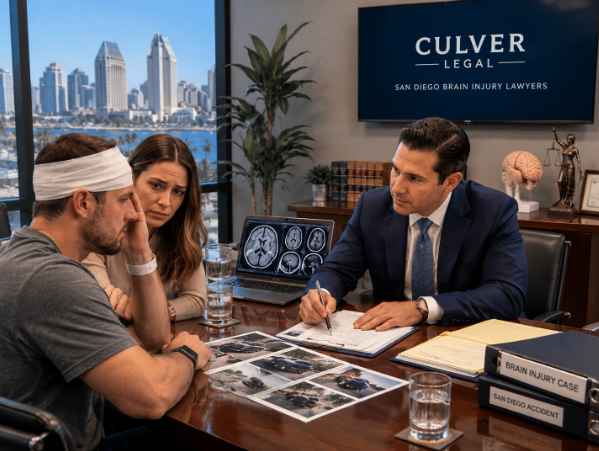
A normal scan is not the same as no injury, and more brain injury claims are lost to that confusion than to any argument about fault.
Imaging is very good at finding bleeding and swelling. It is far less good at showing the kind of injury that leaves someone unable to hold a conversation in a noisy room, or exhausted by four o’clock, or unrecognizable to their own family. Somebody can be discharged the same day with a clean scan and still have their life materially changed.
When the paperwork says nothing happened, the claim has to be built from what did.
Culver Legal, LLP represents people with brain injuries and their families across San Diego County. We work on contingency and advance the costs of the case, so there is nothing to pay up front and no fee unless we win. If there is no recovery, you are not charged those costs either. Call (310) 600-7881 at any hour.
Where the Evidence Actually Lives
In a serious brain injury claim, the medical file is the beginning rather than the whole of it.
The first record matters most, and it is usually the thinnest. What was noted at the scene and in the emergency department about consciousness, confusion, memory of the event and orientation carries weight out of proportion to its length, because it is contemporaneous and nobody wrote it with a claim in mind.
San Diego decides where that record lives before anyone chooses. The county runs a catchment area trauma system: it is divided into geographic zones, each assigned to a specific trauma center, so you were taken to the center for where the injury happened. The adult Level I centers are Scripps Mercy Hospital San Diego and UC San Diego Medical Center, with Rady Children’s Hospital as the pediatric Level I.
The evidence that closes the gap is usually not medical at all. Where imaging is unremarkable, what demonstrates the injury is the difference between the person before and the person after, documented by people with no stake in it:
- Family and partners, who notice what a stranger cannot.
- Employers and colleagues, on work that used to be routine and no longer is.
- Teachers, where a child is involved, because school is a daily standardized test of attention and memory.
- Payroll and performance records, which show change rather than assert it.
- Neuropsychological testing, which measures function rather than looking at structure.
Those accounts are best taken while the change is fresh. People adapt, and a year later they describe the new normal rather than the loss, which quietly understates the claim.
Told the scan was clear, but they are not the same person?
Normal imaging does not mean no injury. What proves it is usually the record of the change, and it is best gathered early.
Why These Claims Should Not Settle Quickly
A brain injury claim settled early is settled on incomplete information, and the information that is missing is usually the expensive part.
The full picture takes time to emerge, particularly where the question is whether someone can return to the work they did before, at the level they did it. Insurers know this, which is why an offer often arrives while the person is still being told to rest and see how things go.
Settling closes everything, including the parts nobody has measured yet: future treatment, future earnings, and any care or support needed later.
Where the injured person cannot manage their own affairs, there are additional steps to take before anything is settled, and they exist to protect them. That is a reason to ask early rather than a reason to delay.
Deadlines, Including the One That Catches Families
Two years from the date of injury under Code of Civil Procedure 335.1.
Where a public entity is involved, it is six months under Government Code 911.2, and no lawsuit can be filed until a written claim has been presented. That applies where a government vehicle was involved, where a public road or property condition contributed, or where a public agency is implicated.
A claim against the City of San Diego goes to its Risk Management Department at 1200 Third Ave., Suite 1000, on the city’s RM-9 form. Since 11 December 2023 the city no longer accepts first-notice claims by email, so it is the portal, mail, or in person. Where San Diego MTS is involved, the claim goes to MTS at 1255 Imperial Avenue instead, because it is a separate public agency.
For a child, the six-month clock is the one to watch. Code of Civil Procedure 352 pauses the ordinary limitation period while a person is under 18, but it does not pause the government claim. Where a child’s head injury involves a public entity, an adult needs to act within months rather than years, and a child’s brain injury is often exactly the case where nobody realizes how serious it was until much later.
Where Would the Case Be Heard?
A brain injury claim is an unlimited civil case, filed at the Hall of Justice, 330 West Broadway, and heard in San Diego County before a San Diego County jury. Where someone died, the claim belongs to the family under a separate statute and is a wrongful death claim.
Head injuries in this county most often arise from car and motorcycle collisions, from being struck on foot or on a bicycle, and from falls, and the underlying claim is built in the ordinary way. What differs is the proof of the injury rather than the proof of fault.
Was a child’s head injury involved with a public entity?
Being a minor pauses the two years but not the six-month claim. That clock is already running.
Why Do San Diego Families Choose Culver Legal?
We treat the normal scan as the starting problem rather than a setback, because that is what the case usually turns on and it is answerable with the right evidence gathered early.
Our team speaks Spanish, Farsi, Filipino, Hindi, Mandarin and Korean.
The economics are simple. Contingency, costs advanced, nothing up front and no fee unless we win. We advance the case costs, and if there is no recovery you are not charged those costs either. Culver Legal has recovered $200 Million and counting, and the phone is answered 24 hours a day.
San Diego Brain Injury FAQs
The CT scan was normal. Does that mean there is no brain injury?
No. Imaging is designed to find bleeding, swelling and structural damage, and it is good at that. It is not designed to show whether attention, memory, processing speed or emotional regulation have changed, and those are what people most often lose. A clean scan rules out some things and rules out nothing about how somebody is actually functioning. Whether an injury exists is a medical question for clinicians, and what a claim needs is documentation of the change.
Can you sue for brain damage?
Yes, where someone else’s negligence caused it. The claim is built like any other injury claim, and what differs is the proof of the injury rather than the proof of fault. That is why the evidence of how somebody functioned before and after matters so much, and why it is worth gathering while the difference is still obvious to the people around them.
How long do brain injury cases take to settle?
Longer than most, and for a reason that works in the injured person’s favor. The claim should not be settled until it is clear where someone has ended up, particularly on whether they can return to their previous work at their previous level. An early offer is priced on the least that will ever be known about the injury. Anyone promising a quick settlement on a brain injury is describing a small one.
Can you recover fully from a brain injury?
That is a clinical question rather than a legal one, and the honest answer is that it varies enormously and no page should tell you what will happen to you. What matters for a claim is that recovery is often uncertain for a long time, which is exactly why settling before the picture is clear is the risk. Your treating clinicians are the people to ask.
My family member cannot manage their own affairs. What happens to the claim?
There are protective steps that have to be taken before a claim is brought or settled on behalf of someone who lacks capacity, and they exist to make sure the settlement is actually in their interests. It is not an obstacle so much as a reason to get advice early, because it affects how and when things can be done.
I am undocumented. Can I bring a claim without putting myself at risk?
Yes, and the protection is stronger than most people expect. Under Evidence Code 351.2, added by AB 2159, evidence of a person’s immigration status is not admissible in a civil action for personal injury or wrongful death, and discovery into it is not permitted either. It cannot be raised at trial and it cannot be asked about beforehand. It is not a question we ask you, and it is not a question the other side gets to ask.
Contact a Culver Legal San Diego Brain Injury Lawyer
The evidence that proves a brain injury is mostly gathered outside a hospital, and it is easiest to gather while the change is still recent. If you or a family member suffered a head injury anywhere in San Diego County, reach us at (310) 600-7881 at any hour. The review costs nothing.
Attorney Advertising. Prior results do not guarantee a similar outcome. Culver Legal, LLP is a California law firm. The information on this page is for general informational purposes and does not constitute legal advice.