We are sorry for your loss, and the most useful thing this page can do is answer the questions that have deadlines attached to them.
Culver Legal, LLP represents families across San Diego County after a death caused by someone else’s negligence. We work on contingency and advance the costs of the case, so there is nothing to pay up front and no fee unless we win. If there is no recovery, you are not charged those costs either. Call (310) 600-7881 at any hour, and there is no obligation in asking.
Who Is Allowed to Bring the Claim?
This is the question families ask first, and the usual summaries of it are incomplete.
Code of Civil Procedure 377.60 sets out who may bring a wrongful death action:
- The surviving spouse, domestic partner, children, and the issue of deceased children. Issue of deceased children means grandchildren whose own parent has died.
- If there is no surviving issue, the people who would be entitled to the decedent’s property by intestate succession. That is a wider group than most people expect, and it is how parents and siblings often qualify.
- Anyone who was dependent on the decedent, which the statute lists as including a **putative spouse, the children of a putative spouse, stepchildren, and parents**.
- A minor who lived in the decedent’s household for the 180 days before the death and depended on them for at least half of their support.
That last category is the one nobody mentions, and it matters in blended and extended families where a child was being raised by someone who was not their legal parent.
The decedent’s personal representative may also bring the action on behalf of those entitled.
One death, one lawsuit
This is the practical consequence and it catches families badly.
California allows a single wrongful death action per death, not one per relative. Everyone entitled has to be brought into the same case. A family member who is left out, or who files separately without the others, creates a procedural problem on top of a bereavement.
So the first task is establishing who is entitled, and doing it before anything is filed. In families that are not straightforward, and many are not, that is worth getting right early rather than unpicking later.
Not sure who in the family is entitled to bring it?
There is only one action per death, and everyone entitled belongs in it. That is worth settling before anything is filed.
What the Claim Can Recover
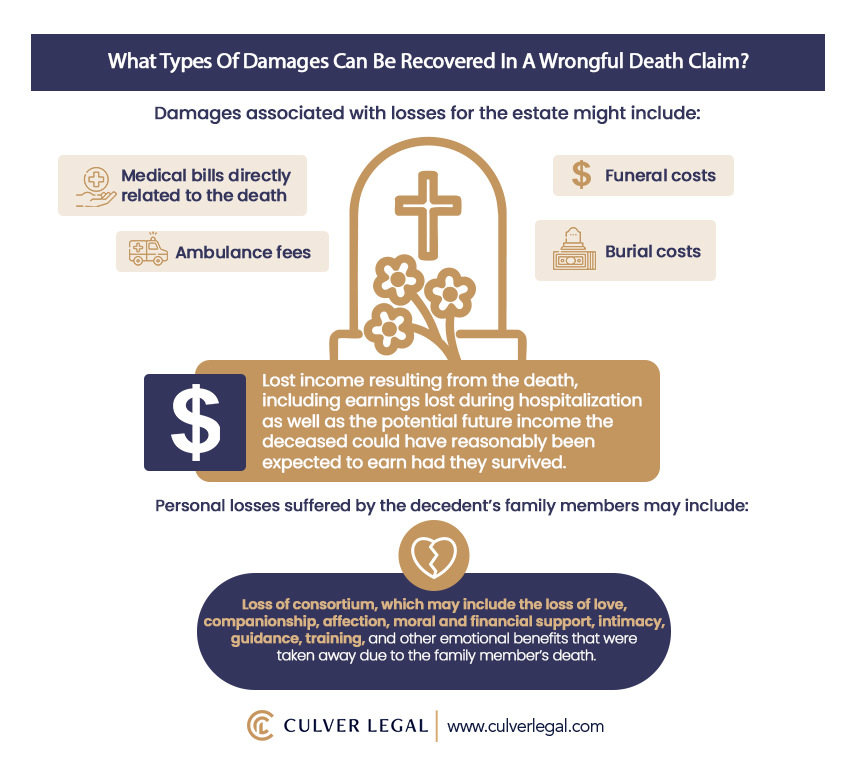
Code of Civil Procedure 377.61 provides that damages may be awarded that, “under all the circumstances of the case, may be just”.
In practice that covers the family’s own losses: financial support the person would have provided, the loss of gifts or benefits, funeral and burial expenses, the reasonable value of household services they performed, and the loss of their love, companionship, comfort, care, assistance, protection, affection, society and moral support.
There is a separate claim that belongs to the estate rather than the family, sometimes called a survival action, covering what the person themselves suffered and lost between the injury and the death. The two run together and are pleaded together, and 377.61 excludes from the family’s claim the damages that belong to that separate one, so keeping them straight matters.
No page can tell you what a claim is worth, and any that offers a figure is describing somebody else’s case.
How Long Do You Have?
Two years from the date of death under Code of Civil Procedure 335.1.
But if a public entity is involved, it is six months, and this is where families lose claims they were entitled to bring.
Under Government Code 911.2 a written claim must be presented within six months, and no lawsuit can be filed until it has been. That applies where a government vehicle was involved, where the road or a public property condition contributed, or where a public hospital or agency is implicated.
A claim against the City of San Diego goes to its Risk Management Department at 1200 Third Ave., Suite 1000, on the city’s RM-9 form. Since 11 December 2023 the city no longer accepts first-notice claims by email, so it is the portal, mail, or in person. Emailing one may mean it was never presented. Where San Diego MTS is involved, the claim goes to MTS at 1255 Imperial Avenue instead, because it is a separate public agency.
Six months is not long when a family is grieving, and that is exactly why it is worth asking early whether it applies, even if nothing else happens for a while.
Where the Case Would Be Heard
A wrongful death claim is an unlimited civil case, filed at the Hall of Justice, 330 West Broadway, which houses the Superior Court’s civil courtrooms, and heard in San Diego County before a San Diego County jury.
The Records, and Why They Matter Early
The evidence in a death case is held by other people and it moves on a schedule that has nothing to do with the family’s grief.
- The collision or incident report. For a city street inside San Diego, that is the **San Diego Police Department. It costs $12, and reports are not faxed or emailed**, so they are collected in person or by mail. Allow three to ten business days, and after seven you can confirm it is ready on (619) 531-2846. A death investigation report may take considerably longer than an ordinary collision report.
- The medical records, from whichever trauma center received them. San Diego runs a **catchment area** system, so which hospital that was depended on where the incident happened rather than on anyone’s choice. The adult Level I centers are Scripps Mercy Hospital San Diego and **UC San Diego Medical Center, with Rady Children’s Hospital** as the pediatric Level I.
- Camera footage, which sits on a retention loop measured in days.
- A vehicle or a scene, which is repaired, cleared or rebuilt.
Nothing about asking for these commits a family to bringing a claim. They are simply gone if nobody asks in time, and a family that decides in three months has fewer options than one that preserved the material in three weeks.
Was a public agency or a public road involved?
Then the deadline is six months from the death, not two years. Ask before it runs, even if nothing else is decided.
Why Do San Diego Families Choose Culver Legal?
We establish who is entitled to bring the claim before anything is filed, because there is one action per death and getting the family right is the part that cannot be corrected easily later.
Our team speaks Spanish, Farsi, Filipino, Hindi, Mandarin and Korean.
The economics are simple. Contingency, costs advanced, nothing up front and no fee unless we win. We advance the case costs, and if there is no recovery you are not charged those costs either. The phone is answered 24 hours a day.
San Diego Wrongful Death FAQs
Who can file a wrongful death lawsuit in California?
Code of Civil Procedure 377.60 sets it out. The surviving spouse, domestic partner, children and the issue of deceased children come first. Where there is no surviving issue, the people who would inherit by intestate succession may bring it, which is how parents and siblings often qualify. Separately, anyone who was dependent on the person who died may bring it, and the statute names putative spouses, their children, stepchildren and parents. There is also a category for a minor who lived in the household for the 180 days before the death and depended on the deceased for at least half their support. The decedent’s personal representative may bring the action on behalf of those entitled.
Can more than one family member file separately?
No, and this surprises people. California allows a single wrongful death action per death rather than one per relative, so everyone entitled has to be joined in the same case. That is why establishing who is entitled comes before filing, particularly in blended families.
How long do we have to bring a claim?
Two years from the date of death in an ordinary case. Where a public entity is involved it is six months, because a written claim must be presented before any lawsuit is possible. That shorter deadline applies if a government vehicle, a public road condition or a public agency contributed, and it is the one families most often lose a valid claim to.
What can a wrongful death claim recover?
The statute allows damages that are just under all the circumstances, which in practice means the family’s own losses: financial support the person would have provided, funeral and burial costs, the value of household services they performed, and the loss of their companionship, care and moral support. A separate claim belonging to the estate covers what the person themselves went through before dying. No honest page can put a figure on either.
Do we have to go to court?
Most cases resolve without a trial, and no family is required to decide that at the start. What is required early is preserving what proves the case, because the records, the footage and the scene move on schedules that do not wait for a family to be ready.
I am undocumented. Can I bring a claim without putting myself at risk?
Yes, and the protection is stronger than most people expect. Under Evidence Code 351.2, added by AB 2159, evidence of a person’s immigration status is not admissible in a civil action for personal injury or wrongful death, and discovery into it is not permitted either. It cannot be raised at trial and it cannot be asked about beforehand. It is not a question we ask you, and it is not a question the other side gets to ask.
Contact a Culver Legal San Diego Wrongful Death Lawyer
If a public agency or a public road was involved, the deadline is six months from the death, and that is worth establishing now even if nothing else is. Reach us at (310) 600-7881 at any hour. The conversation costs nothing and commits you to nothing.
Attorney Advertising. Prior results do not guarantee a similar outcome. Culver Legal, LLP is a California law firm. The information on this page is for general informational purposes and does not constitute legal advice.